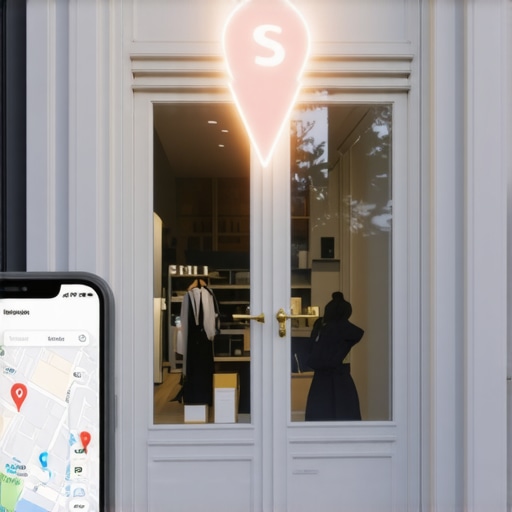
I stood there, staring through the glass of my storefront, watching a group of teenagers pause on the sidewalk. They didn’t look up at my hand-painted sign. They didn’t even glance at the window display I’d spent six hours perfecting. Instead, their heads were buried in their phones, thumbs scrolling through a digital map. That was the moment I realized my physical front door—the one I’d painted a bright, welcoming red—was practically invisible compared to the blue dot on their screens. I was losing customers who were standing ten feet away from me because my google my business rank was non-existent. It’s a gut-wrenching feeling to know you’re the best option in town but effectively invisible to the people who need you right now.
Stop Obsessing Over Your Website and Fix Your Map
We’ve been told for decades that your website is your digital home. That might have been true in 2010, but today, your maps profile is where the first handshake happens. Most local businesses are shocked to find out why your google profile is getting more clicks than your website, often by a ratio of ten to one. I made the classic mistake of pouring my budget into a ‘perfect’ homepage while my local listing gathered digital dust. I even tried to ‘game the system’ by adding extra keywords to my title, which I quickly learned is a recipe for disaster. Today, we’re going to stop the guessing game. I’m showing you exactly how to turn that map pin into a customer magnet.
Is a map profile really worth all this effort?
You might be thinking, ‘Does it really matter if I’m in the top three?’ According to a study by Backlinko, the top three local results—the coveted snack pack—capture a massive 33% of the total clicks. If you aren’t there, you aren’t just losing a few leads; you’re handing your local market to your competitors on a silver platter. Have you ever searched for your own business while standing in the parking lot and realized you’re buried under five other shops? It’s a wake-up call, isn’t it? We’re going to fix why your near me visibility is worse than your actual location so that you finally get the foot traffic you deserve. It’s time to stop letting potential customers walk right past your real door because they can’t find your digital one. Let’s dig into the actual mechanics of making you the most visible shop on the block.
Pick the right lane before you start driving
Your business category isn’t just a label; it’s the specific filing cabinet Google places you in. If you’re filed under the wrong tab, you’ll never be found when the customer starts searching. I remember working with a local plumber who was frustrated because his phone stopped ringing. When we looked at his profile, he had himself listed primarily as a ‘General Contractor’ because he occasionally did bathroom remodels. He was trying to cast a wide net, but he was actually becoming invisible for his core business: emergency repairs. We made one change to his primary category, and his google my business rank for ‘clogged drain’ shot from page four to the top three in forty-eight hours. This is why your business category choice is making you lose money if you aren’t hyper-specific. Think of your primary category like the aisle in a grocery store. If you put the milk in the hardware section, nobody finds it, no matter how fresh it is. You need to stop guessing your categories and use this selection data instead to ensure you are competing where you can actually win.
The subtle tweak that doubles your reach
Most people pick one category and walk away. That’s a massive mistake. You have the ability to add secondary categories, but they must support your main goal. I’ve seen the subtle category tweak that doubled local impressions for a boutique gym simply by adding ‘Weight Loss Service’ as a secondary tag. It opened up an entirely new stream of traffic that the ‘Gym’ category was missing.
Your service area is likely working against you
There is a common myth that the wider you draw your circle on the map, the more people will see you. In reality, Google views a massive, undefined service area as a lack of authority. When you tell the map you service a fifty-mile radius but you’ve never had a customer check-in or a review from the edge of that circle, Google gets suspicious. It’s better to be a king of three zip codes than a ghost in twenty. I learned this the hard way when I tried to claim an entire metro area for a small coffee shop’s catering wing. We vanished from local searches entirely because Google couldn’t verify our relevance across such a huge distance. This is how service areas impact your rankings far more than you think.
Don’t claim territory you can’t defend
You need to be honest about where your customers actually are. If you’re seeing a dip in calls, check why your service area settings are killing your local leads. By tightening your radius to the areas where you actually have a physical presence or a history of service, you increase your ‘proximity trust.’ Google rewards businesses that are clearly local authorities.
The secret language of customer photos
Photos are more than just eye candy; they are data points. Every time a customer uploads a photo of your shop, Google’s AI scans it for landmarks, products, and even the sentiment on people’s faces. I once saw a local bakery jump in rank simply because customers started posting photos of their specific ‘Sourdough Loaf.’ Google saw the bread, read the location data in the photo, and decided this bakery was the definitive answer for anyone searching for sourdough nearby. This is how customer photos change your ranking in just 48 hours. You should be encouraging this constantly because it provides the ‘social proof’ that robots and humans both crave. Use the image metadata strategy for better local visibility to ensure your own uploads are doing the heavy lifting too.Everyone tells you that ‘more is better’ when it comes to feedback, but that is a dangerous oversimplification. In my years of helping businesses achieve map pack domination, I’ve found that quantity is often a vanity metric. If you have five hundred reviews but haven’t received a new one in three months, Google’s algorithm begins to wonder if you’ve gone out of business or lost your touch. This is exactly why having 500 reviews might actually be hurting your visibility if they lack ‘velocity.’ Google rewards active engagement over historical volume. Furthermore, I see business owners wasting hours crafting the perfect bio, completely unaware that why your business description doesnt matter for ranking in the traditional SEO sense. While it helps with customer conversion, it isn’t a direct ranking lever. Instead, you should be focusing on hidden signals like how response speed directly impacts your local map authority. If you’re ignoring messages or taking days to reply, you are signaling to the system that you aren’t the best user experience.
The proximity trap and how to escape it
A common mistake is assuming that being the closest business to a searcher guarantees the top spot. I call this the ‘proximity lie.’ While distance is a factor, Google frequently prioritizes prominence and relevance over a few miles of physical distance. A study by Whitespark on local search ranking factors confirms that high-authority signals can easily leapfrog a closer, weaker competitor. This is the proximity lie why distance isnt the only thing google tracks that catches so many off guard. If you rely solely on your location, you’ll find that why proximity is no longer the only way to win maps becomes a painful reality once an aggressive competitor enters your neighborhood. 
Why does your rank vanish the moment you cross the city line?
This is the ‘Invisibility Border.’ You might be dominating your immediate zip code, but the moment a customer searches from the town next door, you vanish from the snack pack. This happens because your ‘geo-relevance’ is too narrow. This is why your map ranking disappears when you cross city lines even if you are only five miles away. To fix this, you have to stop chasing generic national backlinks and figure out how to identify which local backlinks actually move your rank. Most ‘experts’ will sell you a package of directory links that do nothing. In reality, a single link from a local neighborhood association or a nearby chamber of commerce carries ten times the weight of a standard directory. If you feel like you’re spinning your wheels, it might be why your local seo agency is failing to move the needle by ignoring these hyper-local authority signals. Have you ever fallen into the trap of thinking distance was your only defense? Let me know in the comments.It’s easy to celebrate the day you finally break into the snack pack, but if you stop there, your competitors will eat your lunch by next Tuesday. I’ve seen businesses climb to the top only to fall back to page three because they forgot that local SEO is about momentum, not just milestones. If you want to keep that google my business rank, you have to master the review frequency secret for long term map dominance. It’s not about getting fifty reviews in a weekend; it’s about getting two reviews every week, forever.
Winning the race is only half the battle
I don’t spend all day staring at Google. Instead, I use a lean stack of tools that alert me when things shift. While many people use expensive suites, you can actually learn how to audit your local competitors without expensive tools just by using incognito windows and a little bit of manual scraping. I personally swear by ‘check-in’ apps that allow my team to geo-tag photos from the job site. This is how to use local check ins to boost your business authority by proving to Google that you are actually where you say you are. As Joy Hawkins from Sterling Sky often points out, Google’s ability to detect ‘fake’ engagement is skyrocketing, so these real-world signals are becoming your best defense against algorithmic shifts. 
The software that keeps me sane
I’m often asked which single tool is the ‘silver bullet.’ There isn’t one, but if I had to pick, I’d focus on automated review management. Manually chasing customers is a recipe for burnout. By automating the request process, you ensure a steady ‘pulse’ of fresh content. This helps you how to secure your spot in the map pack permanently because it creates a pattern of reliability that the AI loves.
How do I maintain map pack dominance over time?
Maintenance is about two things: monitoring and reacting. If you see a sudden dip, don’t panic. Learn how to outsmart competition in local map listings in 2025 by looking at their photo update frequency and response times. Usually, they’ve just outpaced you in engagement. I predict that in the next few years, local maps will lean heavily into Augmented Reality (AR) and ‘Real-Time Inventory.’ If your shop shows that a specific item is in stock right now, you’ll leapfrog everyone who only lists their hours. Start mastering local maps domination proven strategies for 2025 success now by treating your profile like a real-time social feed. My challenge to you: go into your dashboard today and upload three photos of your actual work from this week. Don’t use stock photos—Google knows. See how that small injection of ‘freshness’ impacts your views by the weekend.
The Hardest Truths I Learned About Map Pack Domination
In my journey to master the map, I’ve realized that the algorithm isn’t your enemy—it’s actually a very literal-minded robot looking for proof of life. One of the most painful lessons I learned was why you should never use a po box for your business address; Google wants to see a real door, not a metal locker. I also discovered that your site isn’t as disconnected from your map as you’d think. It was a shock to find out why your website speed is secretly tanking your map rank, but once we fixed the load times, our pin jumped significantly. Finally, remember that competition is relative. You might think you’re in a quiet niche, but why your industry category is more competitive than you think often boils down to how many ghost profiles are clogging up your neighborhood. Keep your eyes on the data and stay active.
My Essential Toolkit for Lasting Map Visibility
If you want to maintain your google my business rank, you need the right tools in your belt. First, I recommend following the insights from Sterling Sky; they are the gold standard for real-world testing. For hands-on work, you must learn how to audit your local competitors without expensive tools using simple incognito searches and location-spoofing extensions. I also rely heavily on automated systems to ensure we follow the correct way to ask for reviews without getting flagged. This keeps the review velocity consistent without me having to beg every single customer personally. Lastly, check out the Local Search Forum to see what other owners are experiencing during core updates.
Your Journey Toward Becoming the Local Authority Starts Today
Becoming the top choice in your neighborhood doesn’t happen by accident, but it also doesn’t require a degree in computer science. It requires showing up every day, responding to your customers, and keeping your digital storefront as clean as your physical one. By mastering local maps domination proven strategies for 2025 success, you aren’t just chasing a higher number; you’re ensuring that when someone in your community is in need, you’re the one who answers the call. You’ve got the tools and the knowledge—now it’s time to claim your spot at the top. Have you ever felt like your business was invisible despite being just around the corner from your customers? Let me know in the comments below!
About the Author
Umar Latif
Brand & Marketing Expert · Dubai, UAE
Umar Latif is a seasoned Brand and Marketing Expert based in Dubai, UAE, with a specialized focus on Local SEO and international digital strategy. With extensive experience managing and optimizing websites for a diverse range of international clients, including those in the United States, Umar has developed a deep understanding of the nuances required to dominate local search results. His technical proficiency encompasses comprehensive keyword research and the implementation of advanced Google-centric strategies designed to enhance visibility and drive organic traffic. As a contributor to dominateyourlocalmaps.com, Umar leverages his background in global marketing to provide actionable insights for businesses looking to improve their local map rankings and digital footprint. His approach combines data-driven tactics with a strategic brand perspective, ensuring that local businesses not only rank higher but also resonate with their target audience. Throughout his career, Umar has remained dedicated to staying ahead of search engine algorithm changes to deliver consistent results for his clients. He is deeply passionate about empowering business owners and marketing professionals with the tools and knowledge they need to achieve sustainable growth.