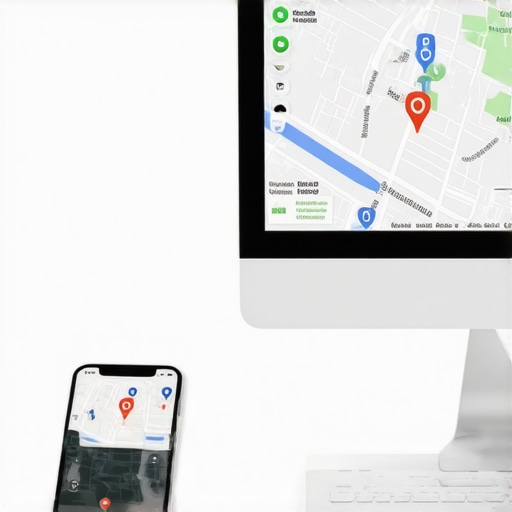
I remember sitting in my truck, parked right outside my own shop, and I decided to do a quick check on my google my business rank. On my laptop that morning, I was sitting pretty in the top three. But on my phone? I wasn’t even on the first page. It felt like I was being pranked by an algorithm. I had spent months on my local mapping strategy, yet I was effectively invisible to anyone walking by with a smartphone. This isn’t just a frustrating quirk; it is a fundamental shift in how Google treats proximity and device intent. Today, I am going to show you exactly why this happens and how you can reclaim your spot in the mobile pack.
The Day I Realized My Business Was Living a Double Life
I once made the mistake of thinking my desktop ranking was the true measure of my success. I ignored my mobile UX because everything looked perfect on my wide-screen monitor. That hubris cost me leads. When you are on a desktop, Google often identifies your location via an ISP hub that might be several miles away. However, on a mobile device, GPS narrows your location down to the very sidewalk you are standing on. This creates a proximity radius that can shrink or expand based on signals we often overlook. Have you ever stood in your own parking lot and failed to find your business on Google Maps? It is a gut-punch, but it is a solvable puzzle. We are going to look at the specific adjustments that force Google to recognize your relevance even when the searcher is on the move.
Is mobile maps domination really worth the extra effort?
Actually, it is the only thing that matters for local growth. According to Statista, mobile devices account for roughly 63% of organic search engine visits. If you are only winning on desktop, you are effectively invisible to more than half of your potential customers. This discrepancy exists because Google prioritizes different data points for mobile users, such as page speed and local map presence, which often lag on older websites. By the end of this guide, you will understand how to use the mobile search trick to bridge this gap and ensure your business shows up exactly where it belongs: at the top of every screen, regardless of the device.
Stop casting such a wide net to catch local fish
To win the map pack, you have to stop treating your profile like a billboard and start treating it like a conversation. You need to move away from the ‘set it and forget it’ mentality. When I was first trying to figure out why my rankings were jumping around, I realized I was suffering from ‘Signal Dilution.’ Many business owners think that by selecting every possible service area, they are telling Google they are a big deal. In reality, you are just whispering to everyone instead of shouting to your neighbors.
Shrink your service area to grow your reach
I remember a plumber in downtown Seattle who was struggling with his google my business rank. He had checked every box from Everett to Tacoma. He was technically ‘everywhere’ but ranked nowhere. We went in and implemented a strategy on how to properly set your service areas to avoid rank dilution. By tightening his radius to a 10-mile circle around his physical shop, his ‘relevance’ score skyrocketed because Google finally knew exactly where to prioritize him. This is the first step in how to beat the proximity filter and expand your reach without moving your physical office. Think of your proximity like a Wi-Fi signal; the further you try to broadcast it, the weaker it gets for everyone.
The speed trap killing your mobile visibility
Next, you must look at your mobile site performance. If your site takes more than three seconds to load on a 4G connection, Google’s mobile crawler is going to punish your map rank. This happened with a boutique gym I worked with last year. They had beautiful, high-res videos on their homepage that looked great on desktop but turned the mobile experience into a frustrating slideshow. We applied a the mobile site fix that improves your local map presence and their calls from ‘gyms near me’ searches doubled in just two weeks. This isn’t just about aesthetics; it is a technical requirement, and ignoring why your website speed is secretly tanking your map rank is the fastest way to stay invisible.
Upload the photos Google actually trusts
Finally, let us talk about visual proof. Google uses machine learning to scan your photos and determine if you actually exist where you say you do. If your photos are all stock images or generic interior shots, you are failing the trust test. You need to identify the one thing google looks for in your storefront photos: permanent, identifiable signage. I once spent an afternoon helping a client take forty photos of their front door from different angles. It felt ridiculous at the time, but knowing how to optimize photos for local search without being a pro changed their entire visibility profile.  This simple act of ‘visual verification’ tells Google your business is a real, tangible place for a mobile searcher to visit right now. If your local maps domination strategy lacks these authentic signals, you are essentially ghosting your own customers.
The counter-intuitive truth about review volume
Most experts will tell you to get as many reviews as possible, as fast as possible. I am here to tell you that is a dangerous game. In my experience, a sudden spike of fifty generic reviews can look like manipulation to Google’s spam filters. You are much better off with a slow, steady stream of high-quality feedback. This is why having 500 reviews might actually be hurting your visibility if they are not optimized for context. Google looks for review velocity and specific keywords within the text. If your reviews do not mention your services or city, they are just empty noise. Have you ever fallen into this trap of chasing quantity over quality? Let me know in the comments.
Avoid the virtual office shortcut at all costs
One of the biggest oops moments I see is business owners trying to game the proximity filter by renting a virtual office or using a PO Box. This is the fastest way to get your profile nuked. Google’s neural networks are incredibly good at identifying these addresses. I have seen years of hard work vanish in twenty-four hours because of the danger of using virtual offices for local seo. If you want map pack domination secrets that actually stick, you need a physical footprint that Google can verify through utility bills or video walkthroughs. Steer clear of the why you should never use a po box for your business address trap; it is a short-term gamble with a long-term penalty.
How can you tell if your secondary categories are cannibalizing your primary search power?
This is a sophisticated nuance that most beginners miss. You might think adding ‘General Contractor’, ‘Plumber’, and ‘Electrician’ helps you show up everywhere, but it often confuses the algorithm. This leads to a situation why your business categories might be fighting each other, where you rank 5th for everything instead of 1st for your main service. A study by BrightLocal confirms that category relevance remains a top-three ranking factor. If you are not seeing the needle move, you need to how to outsmart competition in local map listings in 2025 by narrowing your focus to what you actually do best. Dealing with a how to handle a sudden map ranking plateau without buying links often starts with auditing these overlapping categories.Maintaining that hard-earned spot is where the real work begins. I’ve seen too many people achieve map pack domination secrets only to lose them three months later because they stopped feeding the beast. If you think you can walk away once you hit the top three, you are leaving the door wide open for a hungrier competitor to outsmart competition in local map listings in 2025. I personally don’t trust the monthly automated PDF reports that most agencies send out. They are often lagging indicators. Instead, I use local grid tracking tools that show me exactly how my ranking looks every 500 feet. This is the only way to catch a proximity glitch before it turns into a total blackout.
Stop trusting automated reports that lie to you
The problem with most ‘rank trackers’ is that they check from a single IP address. To truly master local maps domination, you need to see the ‘heat map’ of your visibility. When I see my ‘green circles’ turning yellow on the edge of town, I don’t panic. I look for which local backlinks actually move your rank in that specific zip code. Usually, it is because a competitor picked up a mention in a local neighborhood blog that I ignored. According to Mike Blumenthal, a leading authority in local search, Google is increasingly using ‘Local Justifications’—those little snippets of text like ‘Their website mentions…’—to decide who gets the click. This means your long-term local mapping strategy must include updating your on-site content to match the specific way people talk in your service area.
How can I keep my map spot without checking it every hour?
The secret is ‘Signal Stacking.’ Instead of doing one big SEO push a year, you need to automate the boring stuff so you can focus on the high-impact moves. I recommend setting a weekly calendar invite to perform a 10-minute audit step that finds why your business is hidden. During this time, look for ‘ghost’ listings or new competitors using virtual offices for local seo and report them. Cleaning up the map isn’t just being a snitch; it is protecting your digital real estate.  In the next year, I predict Google will move toward ‘Video-First Verification.’ We are already seeing the secret signal google uses to verify your storefront through mandatory video uploads for new profiles. Expect to have to do this annually to keep your ‘Verified’ badge. If you want to stay ahead, start recording short, 15-second clips of your team at work and uploading them as updates. It’s a low-effort move that provides massive trust signals. If you are currently stuck, I want you to try this one advanced tip: go into your photo gallery and apply the specific photo metadata that actually moves your map rank to your five newest images. It’s the closest thing to a ‘force refresh’ button Google has.
The Expensive Lessons That Changed My Mind About Google Rankings
I used to think more was always better. More service areas, more keywords, more everything. I was wrong. The biggest breakthrough came when I stopped trying to trick the algorithm and started trying to help it. For example, I found that the real reason your profile ranking stalled last month usually has more to do with your recent engagement levels than your historical data. Google rewards the ‘freshness’ of your interaction.
Another huge shift for me was realizing why proximity is no longer the only way to win maps. Trust and authority can actually ‘stretch’ your radius beyond your physical walls if you build the right local signals. If you are only relying on being the closest shop, you are vulnerable to any competitor who builds more digital trust.
Lastly, don’t ignore the technical side of your site. I have seen profiles effectively die because of the hidden schema error hiding your business from searchers. If the code on your website doesn’t match your map profile exactly, Google gets confused and simply stops showing you to new customers. Details are the difference between first and fourth place.
My Go-To Resources for Staying Ahead of the Algorithm
If you are serious about this, you need the right gear. I personally rely on BrightLocal for deep dives into local citations; it is the gold standard for seeing what your competitors are doing behind the scenes. I also check the Google Business Profile Help Community daily; it is where real-time bugs and algorithm shifts get reported by volunteers before they hit the mainstream news.
For tracking your progress, you should learn how to audit your local competitors without expensive tools. This allows you to see where they are vulnerable in their own neighborhoods. And of course, I keep a digital copy of mastering local maps domination proven strategies for 2025 success bookmarked. The rules for mobile visibility change almost quarterly, and staying current is your only real defense.
Your Journey Toward Map Pack Domination Starts Now
You now have the blueprint. The distance between where you are and where you want to be is simply a matter of execution. Don’t let the technical jargon or the constant updates intimidate you. Start with one small, meaningful change today—perhaps a better response to a recent review or a quick audit of your mobile load time. Every action you take builds the momentum needed for map pack domination secrets to start working in your favor. Your business deserves to be found, and your community is searching for exactly what you offer. Go reclaim your spot at the top. Have you ever noticed your ranking drop suddenly after making a small change to your business description? Let me know your experience in the comments!
About the Author
Umar Latif
Brand & Marketing Expert · Dubai, UAE
Umar Latif is a seasoned Brand and Marketing Expert based in Dubai, UAE, with a specialized focus on Local SEO and international digital strategy. With extensive experience managing and optimizing websites for a diverse range of international clients, including those in the United States, Umar has developed a deep understanding of the nuances required to dominate local search results. His technical proficiency encompasses comprehensive keyword research and the implementation of advanced Google-centric strategies designed to enhance visibility and drive organic traffic. As a contributor to dominateyourlocalmaps.com, Umar leverages his background in global marketing to provide actionable insights for businesses looking to improve their local map rankings and digital footprint. His approach combines data-driven tactics with a strategic brand perspective, ensuring that local businesses not only rank higher but also resonate with their target audience. Throughout his career, Umar has remained dedicated to staying ahead of search engine algorithm changes to deliver consistent results for his clients. He is deeply passionate about empowering business owners and marketing professionals with the tools and knowledge they need to achieve sustainable growth.