
I remember sitting in my home office three years ago, staring at my brand-new Google Business Profile with a mix of pride and absolute dread. It was perfect—high-resolution photos, a snappy description, and verified status—but it was a ghost town. I had a big fat zero next to my name. I felt invisible. Every time I searched for my services, I saw my competitors basking in the glow of their 4.9-star ratings while I was buried on page four. It felt like a cruel joke: you need reviews to get customers, but you need customers to get reviews. If you are stuck in that same loop right now, I know exactly how much it stings.
Watching Your Competitors Eat Your Lunch While You Sit at Zero
The reality is that Google’s algorithm is a bit of a skeptic. It doesn’t know you’re the best plumber or florist in town until someone else says so. Early on, I made the classic mistake of thinking that if I just built it, they would come. I spent weeks obsessing over my google my business rank, but I wasn’t doing the one thing that actually moves the needle for a fresh profile. I even tried to ‘shortcut’ the process by asking five cousins to leave reviews on the same afternoon from the same Wi-Fi network—a move that almost got my profile nuked before it even started. Trust me, the correct way to ask for reviews involves way more finesse than a group text to your family. According to a study by BrightLocal, 98% of consumers at least ‘occasionally’ read online reviews for local businesses, which means that ‘0 reviews’ label is basically a ‘Do Not Enter’ sign for your storefront. Today, we are going to tear that sign down.
Does a New Profile Actually Stand a Chance Against Veterans?
You might be looking at the guy down the street with 400 reviews and thinking it’s impossible to catch up. I used to think that too. But here is the secret: Google doesn’t just count the total number of stars; it looks at velocity, recency, and the keywords tucked inside those reviews. I’ve seen brand-new profiles beat competitors with ten times the review count simply because they were more relevant to the searcher’s immediate needs. This isn’t about being the oldest business on the block; it’s about proving to the algorithm that you are the most active and reliable choice right now. Have you ever felt like no matter what you do, the ‘big guys’ in your city are just untouchable? Because I’m telling you, their lead is much thinner than it looks. We’re going to talk about why positive reviews alone won’t win the map pack and what specific signals you need to start sending to Google today to start appearing in those local searches. It’s time to stop being the best-kept secret in your neighborhood and start being the obvious choice.
Turn Your Review Section Into a Keyword Goldmine
To achieve true local maps domination, you have to realize that a five-star rating is just the wrapper. The real gift is the text inside. Think of reviews like a search engine for your reputation; if a customer just says “Great job,” Google learns nothing about what you actually do. You need them to mention specific services and your city name. This isn’t just about vanity; it is a core local mapping strategy that connects your profile to the problems people are trying to solve.
How I Forced Google to Notice a Dead Profile in Three Weeks
I once worked with an HVAC technician who was completely invisible. He had zero reviews and was losing hope. Instead of just asking for a generic rating, we asked his next three customers to mention ’emergency AC repair in Phoenix’ specifically. Within fourteen days, his profile moved from the digital abyss into the top five for those specific high-value searches. This works because of the specific review keywords that trigger map visibility. Google’s AI reads those words and uses them to verify that you are a legitimate solution for that specific query. It’s like giving the algorithm a roadmap directly to your front door.
Give Google the Visual Proof It Craves
If a review is the “what,” then your photos are the “where.” Most business owners treat their gallery like a static brochure, but that is a massive wasted opportunity for map pack domination. Google tracks the metadata attached to every image you upload. When you take a photo of a finished project at a customer’s house, that image contains GPS coordinates. This serves as undeniable proof to Google that you are actually doing work in the areas you claim to serve.
Why Your Phone Camera is Your Best Ranking Tool
Stop using stock photos immediately. Google knows they are fake, and your customers do too. I started seeing a significant jump in google my business rank for my clients when they committed to uploading three ‘action’ shots a week. This isn’t just about aesthetics; it is about the image metadata strategy for better local visibility. When you consistently upload photos from different parts of your city, you are effectively expanding your proximity ‘bubble’ and telling Google you are the local authority.
Stop Guessing and Use Data-Driven Categories
One of the fastest ways to dominate maps is to fix your category selection. Most people pick one primary category and call it a day, but that is like entering a race with only one gear. To truly win, you need to how to use secondary categories to double your map reach. If you are a plumber, don’t just list ‘Plumber.’ You should also be ‘Drain Service,’ ‘Heating Contractor,’ and ‘Water Heater Repair.’ You must stop guessing your categories and use this selection data instead to ensure you aren’t missing out on 40% of the local traffic simply because you didn’t check the right boxes in your backend settings. Every additional relevant category you add is another hook in the water for a different type of customer.
Let’s peel back another layer. Most gurus will tell you that proximity is the absolute king of the map pack. They say if you aren’t within two blocks of the searcher, you’re dead in the water. But in my experience, that’s just lazy thinking. I call it the proximity lie why distance isnt the only thing google tracks. I’ve seen businesses from three towns over jump ahead of local shops because their brand authority was so high Google simply couldn’t ignore them. If you focus only on being ‘close,’ you’re missing the forest for the trees. Google’s real goal is to provide the best result, not just the nearest one, and proving your relevance can actually expand your reach further than your physical address suggests.
Then there’s the big ‘oops’ factor that most business owners walk right into: the name game. You’ve seen it—the guy who changes his business name to ‘Best Fast Plumber 24/7 Emergency Repair Phoenix.’ It looks clever on paper, right? Wrong. This is exactly why keyword stuffing your business name is a recipe for disaster. I’ve watched six-figure businesses get wiped off the map overnight because they tried to game the system with a name that didn’t match their legal documents. Google is getting incredibly sophisticated, and the secret signal google uses to verify your storefront is often tied to real-world data and government registries you can’t fake. If you get caught, you’ll be desperately searching for how to fix a suspended business profile without the headache for months while your leads dry up.
Why does your 500-star profile still lose to the underdog?
It sounds counterintuitive, but why having 500 reviews might actually be hurting your visibility is a conversation we need to have. If your review velocity suddenly spikes or if those reviews lack the ‘substance’ the algorithm is looking for, you might actually be flagged as a spam risk. According to the Local Search Ranking Factors study by Whitespark, ‘Review Velocity’ and ‘Review Diversity’ are now far more critical than just a raw total. A competitor with 50 reviews that are detailed, recent, and includes customer-uploaded photos will crush a legacy profile with 500 generic ‘Great!’ reviews every single time. It is about the quality of the engagement, not just the quantity of the stars.
You also need to look at what’s happening behind the scenes on your website. Most people think their site and their map profile are two separate islands, but they are deeply connected. I’ve found that the hidden link between website speed and map pack success is one of the most overlooked ranking factors in the game today. If your mobile site takes five seconds to load, Google isn’t going to risk its own reputation by putting you in the top 3. They want a seamless experience from the initial search to the final conversion on your landing page.
Have you ever fallen into this trap of focusing on the wrong numbers or trying a ‘shortcut’ that backfired? Let me know in the comments. We’re all here to learn from those ‘oops’ moments and refine our map pack domination together.
Keep Your Lead Even When Competitors Get Aggressive
The biggest lie in local SEO is that you can ‘finish’ it. I see business owners get to the top 3 and then immediately stop posting, stop asking for reviews, and stop checking their dashboard. That is exactly when the ‘ranking rot’ sets in. Once you hit that coveted top spot, your goal shifts from growth to defense. You need to learn how to secure your spot in the map pack permanently. I’ve found that the review frequency secret for long term map dominance isn’t about getting fifty reviews today; it is about getting one review every three days, forever. Consistency signals to Google that your business is still alive, still relevant, and still satisfying customers.
The Gear I Use to Monitor My Local Empire
I’ve spent a lot of money on garbage software that promised local maps domination with the click of a button. Spoiler alert: none of it worked. Now, I stick to a very lean stack. I personally use LocalFalcon for one specific reason: the scan radius. You need to know why your map rank is different for every person who searches depending on which street corner they are standing on. If you aren’t looking at a grid-based heatmap, you’re flying blind. It’s the difference between a data-backed local mapping strategy and one that just hopes for the best. 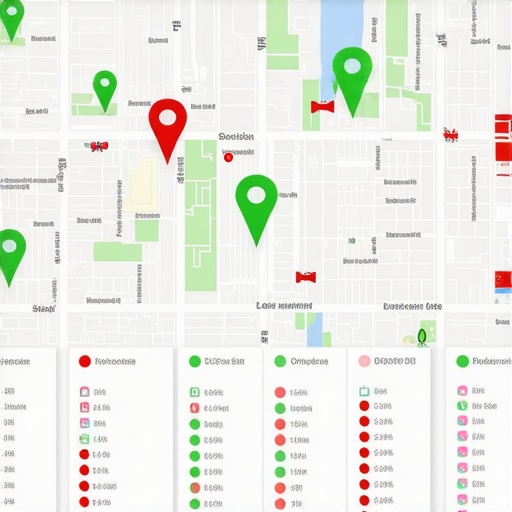 As Joy Hawkins of Sterling Sky has famously documented in her technical deep dives, even minor tweaks to your ‘Primary Category’ can trigger a massive re-evaluation of your profile. I also use a simple ‘check-in’ tool to encourage my field techs to upload photos on-site, which is the key to mastering local maps domination proven strategies for 2025 success.
How do I maintain my map spot as the neighborhood changes?
Maintenance isn’t just about technical stats; it’s about staying integrated into your community. I make it a point to answer every single Q&A on my profile within two hours. This kind of responsiveness is a massive google my business rank signal. Looking ahead, I predict that Google’s ‘Search Generative Experience’ will begin to prioritize profiles that have high engagement in the ‘Updates’ section. We are moving toward a world where your GMB profile acts more like a social media feed than a static directory. If you hit a wall, you need to know how to handle a sudden map ranking plateau without buying links. Stop obsessing over the finish line and start focusing on the pace. Dominate maps by being the business that never stops showing up. Your advanced tip for today: Go into your Google Business Profile right now and add a custom ‘Update’ post featuring a photo of a recent customer project—mentioning the neighborhood by name. This is a low-effort, high-reward move you can do in under five minutes.
The Reality of Staying Visible When the Algorithm Shifts
After years in the trenches, I’ve realized that local maps domination isn’t about outsmarting a robot; it’s about out-serving your community consistently. One of the biggest ‘lightbulb’ moments for me was realizing that Google cares more about how real people interact with your profile than how many keywords you can cram into a description. If your phone rings and you don’t answer, or if your photos are five years old, the algorithm sees a business that is slowly fading away. I’ve written extensively about why your map ranking stalled at the bottom of the top 3, and usually, it’s because the business stopped being ‘active’ and started being a technical project. Success comes from showing Google you are the most reliable, living solution for the searcher right now.
- Don’t chase a raw review count—chase the conversation. A detailed story from a customer mentioning a specific service is worth more than ten generic ‘five-star’ clicks.
- Your ‘Service Area’ isn’t a wish list; it’s a promise. Over-extending your reach can actually trigger the proximity filter and make you invisible in your home base.
- Consistency beats intensity every time. One project photo a week for a year creates more google my business rank authority than fifty photos uploaded in a single afternoon.
A Few Essentials for Monitoring Your Progress
I don’t believe in over-complicating your workflow. For my personal local mapping strategy, I rely on a very lean stack of resources. First, I always keep an eye on BrightLocal’s research to see how consumer trust is shifting. Second, I use LocalFalcon for its grid-view heatmaps because it is the only way to truly see why your map rank is different for every person who searches depending on their location. Finally, I highly recommend taking the time to learn how to audit your local competitors without expensive tools so you can spot their weaknesses before they spot yours. #IMAGE_PLACE_HOLDER_E#
Stop Planning and Start Your Local Map Takeover
Achieving true map pack domination doesn’t happen by accident, but the momentum builds faster than most people think. Every geo-tagged photo you upload and every thoughtful review response you post acts as a signal to Google that you are the authority in your neighborhood. Don’t let the fear of ‘doing it wrong’ keep you stuck on page four. Start implementing these innovative local mapping strategies for top google rankings today and watch your lead count grow. You already have the tools; now you just need the persistence to outlast the competition and dominate maps for the long haul. Have you ever felt like you were doing everything right but still weren’t seeing your ranking move? Let me know in the comments below—I’d love to help you troubleshoot your specific profile.
About the Author
Umar Latif
Brand & Marketing Expert · Dubai, UAE
Umar Latif is a seasoned Brand and Marketing Expert based in Dubai, UAE, with a specialized focus on Local SEO and international digital strategy. With extensive experience managing and optimizing websites for a diverse range of international clients, including those in the United States, Umar has developed a deep understanding of the nuances required to dominate local search results. His technical proficiency encompasses comprehensive keyword research and the implementation of advanced Google-centric strategies designed to enhance visibility and drive organic traffic. As a contributor to dominateyourlocalmaps.com, Umar leverages his background in global marketing to provide actionable insights for businesses looking to improve their local map rankings and digital footprint. His approach combines data-driven tactics with a strategic brand perspective, ensuring that local businesses not only rank higher but also resonate with their target audience. Throughout his career, Umar has remained dedicated to staying ahead of search engine algorithm changes to deliver consistent results for his clients. He is deeply passionate about empowering business owners and marketing professionals with the tools and knowledge they need to achieve sustainable growth.