I remember the day I signed the lease on that shiny new downtown office like it was yesterday. I was convinced that being closer to the ‘action’ would finally get me that elusive number one spot. I spent thousands on the move, updated my stationery, and waited for the phone to ring. Instead, it went silent. I had fallen headfirst into the exact trap we are talking about today. My local mapping strategy was based on an outdated myth, and it nearly cost me my entire service-based business. Most people think that being at the dead center of a city is the golden ticket to map pack domination, but the reality is far more complex and, frankly, a bit frustrating if you aren’t prepared for it. [image placeholder]
Stop Obsessing Over Your Office Zip Code
For years, the mantra was simple: proximity is king. While it is true that Google wants to show searchers the closest relevant results, there is a phenomenon I call the proximity paradox that catches well-meaning owners off guard. If you are crammed into a high-density area with fifty other competitors in the same building or block, Google’s filter often hides all but the most ‘authoritative’ one. By moving to what I thought was a prime spot, I actually entered a filter zone that made me invisible. We are going to fix that for you today by looking at how to increase your map radius without having to sign another lease.
Does a downtown address actually guarantee more calls?
Many of my neighbors in the local SEO world still cling to the idea that a ‘city center’ pin is the only way to win. However, since the 2021 Vicinity update, Google has significantly rebalanced the scales. According to research from Sterling Sky, the weight of proximity has shifted, often favoring relevance and prominence over raw distance. This means your google my business rank depends more on how you interact with your service area than where your desk is bolted to the floor. Have you ever noticed your rankings drop off a cliff the moment you drive two miles away from your shop? If so, you’re likely being throttled by a narrow proximity filter. I want to know—have you ever considered moving just to rank better, or have you already made that jump and regretted it? Let’s dive into why proximity is no longer the only way to win maps and how you can reclaim your territory.
Clean Up Your Category Mess Before Doing Anything Else
One of the fastest ways to kill your google my business rank is to confuse the algorithm about what you actually do. I once worked with a local landscaping pro who was frustrated that he wasn’t appearing for high-value lawn care searches. It turned out he had selected ‘General Contractor’ as his primary category because he occasionally built decks. By trying to be everything to everyone, he became nothing to Google. You need to stop guessing your categories and look at what the top three performers in your niche are actually using. If you have too many conflicting labels, you’re essentially telling Google you aren’t an expert in anything. This is a classic case of why your business categories might be fighting each other and dragging your visibility into the gutter.
Force Google to Notice Your Real World Popularity
Ranking isn’t just about keywords; it’s about signals. Think of local maps domination like a popularity contest where Google is the judge watching the crowd. Every time someone clicks your ‘Call’ button or asks for directions, it’s a vote of confidence. I remember a small coffee shop owner who outranked a massive franchise across the street just by encouraging customers to upload photos of their latte art while sitting in the shop. This generated geo-tagged interaction data that screamed relevance to the algorithm. You can achieve this by looking into the interaction data that proves you are a top local choice. It’s not just about getting the click; it’s about what happens after the click. If people bounce back to the search results immediately, you’re telling the system you weren’t the right answer.
Stop Letting Your Competitors Steal Your Clicks With Better Visuals
Most business owners treat their profile photos like an afterthought—a blurry shot of the front door and maybe a logo. That is a massive mistake. High-quality, original images are your first line of defense against the scroll. I’ve seen a simple change in the cover photo result in a 20% jump in click-through rate. When you implement the image optimization trick that increases local CTR, you aren’t just looking pretty; you are signaling to Google that you are an active, trustworthy business. Use the specific alt text strategy for local business photos to give the algorithm context that it can’t get from a raw file. I once spent three hours renaming and tagging every photo for a local plumber, and within two weeks, his profile was showing up for terms he’d never even touched before. It felt like a cheat code for map pack domination.
Break Through the Proximity Wall Without Moving
If you feel stuck in a tiny three-block radius, you are likely hitting a filter wall. To dominate maps across an entire city, you have to prove your authority extends beyond your front door. This involves more than just adding service areas in your dashboard; it requires building local signals that connect your website to specific neighborhoods. You have to learn how to beat the proximity filter and expand your reach by creating location-specific content that actually matters to those residents. I once helped a locksmith who was invisible ten miles out. We started documenting jobs in those far-off suburbs with photos and short blurbs on his site, then linked them to his profile. Suddenly, the ghost zones started showing his pin. This is the local mapping strategy that separates the pros from the amateurs.
Why raw review counts are lying to you
Most experts tell you that if you want to dominate maps, you just need to chase more reviews. In my experience, that is a dangerous oversimplification. I’ve seen businesses with a fraction of the review count leapfrog over established giants. The secret isn’t the quantity; it’s the sentiment and the authority of the reviewer. This is why your competitor with fewer reviews is outranking you. Google looks for specific ‘justification’ keywords within those reviews that match the searcher’s intent. If your customers just leave five stars without a comment, they aren’t helping your local mapping strategy as much as you think. A single detailed review from a Level 7 Local Guide often carries more weight than ten anonymous ‘Great service!’ blurbs.
Stop flushing money down the citation drain
There is a massive ‘oops’ factor in the local SEO world regarding citations. Many owners are still paying agencies to build hundreds of directory links on obscure sites. The reality? Google ignores almost all of them. According to the 2023 Local Search Ranking Factors study by Whitespark, the importance of general citations has plummeted. You should stop wasting cash on local citations that google ignores and focus strictly on high-authority, niche-relevant ones. If your NAP (Name, Address, Phone) data is messy on these few major sites, that is where the real damage happens. Have you ever fallen into this trap? Let me know in the comments.
Can a faster website actually move your pin on the map?
This is a question I get from savvy owners who have already mastered the basics of their profile. The answer is a resounding yes. There is a deep link between website speed and local map presence that most people ignore. If your landing page takes five seconds to load on a mobile device, Google is less likely to feature you in the top three because it provides a poor user experience. To achieve true map pack domination, you must sync your website schema with your map profile to create a unified signal. When your site is fast and your data is structured, your google my business rank starts to move in ways that basic profile edits simply can’t match. Mastering local maps domination requires looking at the technical foundation of your entire digital presence, not just the pin on the map.
I’ve learned the hard way that map pack domination isn’t a trophy you win once and put on a shelf; it’s more like a garden that needs constant weeding. Once you’ve built that technical foundation, the real challenge is scaling your results without letting the daily grind eat you alive. For me, the game-changer was moving away from vanity metrics and toward real-time grid tracking. If you aren’t using a tool like Local Falcon or BrightLocal to see exactly where your pin drops off, you are essentially flying blind. I personally use these grid tools every Tuesday morning because they reveal the ‘hidden’ walls where my google my business rank starts to fail. It’s the only way to know if you need to audit your map rankings from a customers real location or if your competition is simply out-hustling you in a specific neighborhood. 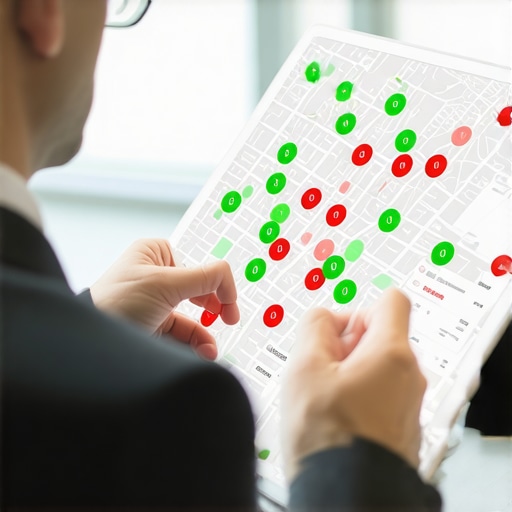
Stop flying blind with your data
Many owners ask me why they should pay for software when they can just search for themselves on their phones. The reason is simple: Google knows who you are. Your personal search results are biased by your history and your physical presence in the office. To truly dominate maps, you need objective data that shows how a stranger three miles away sees you. This is where the power of regular profile updates on search frequency becomes undeniable. When I started treating my profile like a social media feed—posting updates at least twice a week—my ‘ranking floor’ rose significantly. I stopped seeing those massive weekend dips that used to drive me crazy.
How do I keep my map ranking alive forever?
Maintenance isn’t just about avoiding penalties; it’s about staying ahead of the curve. According to the latest data from the Whitespark Local Search Ranking Factors survey, ‘signals of life’ are becoming more important than legacy citations. This means you need a consistent local mapping strategy that includes responding to every single review and answering those weird ‘Questions & Answers’ that pop up on your profile. If this sounds like too much work, you might realize why hiring a google business profile consultant saves more money than diy management in the long run. Looking ahead, I predict that AI-driven visual search will be the next big hurdle. Google is already getting better at ‘reading’ what is inside your shop photos without you telling it. That’s why you need to start implementing 5 crucial tweaks for google maps seo in 2026 that actually stick right now. Don’t wait for your traffic to drop before you start caring about these shifts. My challenge to you today: log in to your profile right now and post one high-resolution photo of your team in action. It’s the simplest way to signal to the algorithm that you’re still the best choice in town.
The Hard Truths I Discovered While Climbing the Local Search Ladder
Getting your google my business rank to the top isn’t just about a one-time optimization. One of the biggest lessons I learned is that why your competitor with fewer reviews is outranking you often comes down to the actual authority of those reviews rather than the sheer number. I used to think I could just automate my local mapping strategy, but Google can smell a lack of authenticity from a mile away. If you aren’t engaging with your customers through google business posts, you’re leaving money on the table for your competitors to grab. I also realized that why your website speed is secretly tanking your map rank is the most overlooked technical factor today. Your mobile load time is essentially your map ticket.
[image placeholder]
The Tools That Keep My Business in the Top 3
I don’t leave my map pack domination to chance, and neither should you. I rely on a few specific resources to maintain my edge. First, I use Local Falcon to perform a real-world scan of my visibility. This helps me audit your map rankings from a customers real location without the bias of my own office IP address. Second, I constantly refer back to the proven strategies for 2025 success to ensure I’m not using outdated tactics in a competitive world. Finally, a simple high-res camera on your phone is your best friend—uploading fresh, geo-tagged photos regularly is the ultimate signal of life to the algorithm.
Your Roadmap to Final Map Pack Domination
The journey to dominate maps is a marathon, not a sprint. It’s easy to get discouraged when you see a dip, but remember that local search is a living ecosystem. If you stay consistent with your innovative local mapping strategies, you will eventually outpace those who only put in the effort once. You have the tools, you have the data, and now you have the strategy. Don’t let your profile become a digital ghost town. Go out there and claim your spot at the top of the pack. Have you ever struggled with a competitor who seems to rank for everything despite having fewer reviews? Let me know in the comments below!
About the Author
Umar Latif
Brand & Marketing Expert · Dubai, UAE
Umar Latif is a seasoned Brand and Marketing Expert based in Dubai, UAE, with a specialized focus on Local SEO and international digital strategy. With extensive experience managing and optimizing websites for a diverse range of international clients, including those in the United States, Umar has developed a deep understanding of the nuances required to dominate local search results. His technical proficiency encompasses comprehensive keyword research and the implementation of advanced Google-centric strategies designed to enhance visibility and drive organic traffic. As a contributor to dominateyourlocalmaps.com, Umar leverages his background in global marketing to provide actionable insights for businesses looking to improve their local map rankings and digital footprint. His approach combines data-driven tactics with a strategic brand perspective, ensuring that local businesses not only rank higher but also resonate with their target audience. Throughout his career, Umar has remained dedicated to staying ahead of search engine algorithm changes to deliver consistent results for his clients. He is deeply passionate about empowering business owners and marketing professionals with the tools and knowledge they need to achieve sustainable growth.