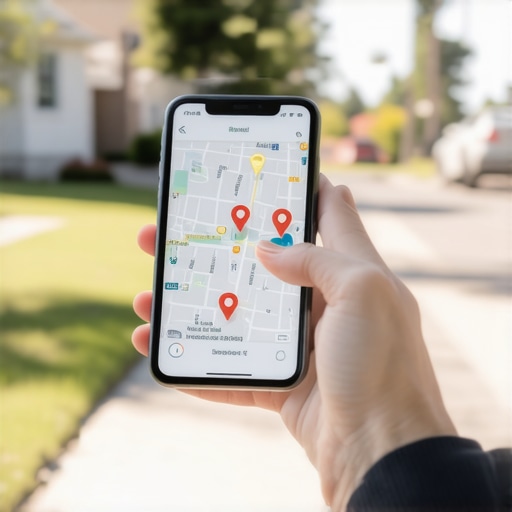
I was sitting in a booth at the diner just two miles down the road from my storefront, waiting for a lukewarm coffee, when I decided to do a quick check on how we were doing. I pulled out my phone, typed in our main service, and held my breath. I expected to see our name glowing at the top of the pack. Instead, I saw three competitors I’d never even heard of. My heart sank. Back at the office, my desktop tracker told me we were #1. In the real world, standing where my customers stand, we were invisible. It was a punch to the gut that changed my entire approach to map pack domination.
Stop Trusting the Screen in Your Office
That afternoon was a massive wake-up call for my local mapping strategy. I realized that most of us are essentially ghost hunting—looking for rankings that don’t exist for the people who actually want to buy from us. If you are only checking your google my business rank from your own desk, you are seeing a version of reality that is heavily skewed by your office Wi-Fi and your own search history. It is a bubble. And bubbles eventually pop. Today, I want to show you how to break out of that bubble and see exactly what is happening on the ground.
We are going to dive into the nitty-gritty of auditing your presence from the perspective of a person walking down the street, not an algorithm sitting in a server farm. We will fix the audit mistake that makes your map listing effectively invisible to 90% of your potential local leads. Have you ever felt like you’re doing everything right with your profile, yet the phone just refuses to ring? That disconnect usually happens right here, in the gap between your dashboard and the street corner.
Is this audit actually worth the time and effort?
I get it. You are busy. You have a business to run and a thousand fires to put out. But here is the cold, hard truth: proximity is the single most influential ranking factor in local search. According to data shared by Search Engine Land regarding the Possum update, a user’s physical location can shift search results by over 60% within just a few blocks. If you aren’t checking from multiple physical locations, you are essentially flying blind through a storm.
Earlier in my career, I made the classic mistake of thinking that more reviews would solve everything. I spent months obsessed with the more is better approach, only to find out that a competitor with half my reviews was outranking me because they had optimized for the exact radius where your local rankings drop off. I was winning the popularity contest but losing the location war. It is time to stop guessing and start seeing the map through your customer’s eyes. Let’s look at how we can leverage a 10-minute local SEO audit that actually reflects the real world and gets your phone ringing again.
Ditch the Desktop and Hit the Pavement
The first rule of map pack domination is simple: the desktop is a liar. To get an accurate reading, you need to perform what I call a ‘Grid Walk.’ Grab your smartphone, disable your office Wi-Fi, and head to four different points—North, South, East, and West—about a half-mile away from your front door. Search for your core service at each stop. This reveals the exact radius where your local rankings drop off. If you vanish the moment you cross the main intersection, you don’t have a ranking problem; you have a proximity-signal problem. Think of your business profile like a radio station; if your signal is weak, listeners only hear static once they drive over the hill.
Fix the Category Mismatch Killing Your Visibility
I once worked with an HVAC contractor who was tearing his hair out because a guy with three reviews was outranking him. When we looked under the hood, we found the issue: my client had set his primary category to ‘General Contractor’ because he wanted the ‘big’ jobs. But customers were searching for ‘AC Repair.’ By choosing the wrong bucket, he was effectively shouting into a void. This is exactly why most business owners pick the wrong categories and unintentionally sabotage their own growth. Your primary category should be the most specific match for your most profitable service, not a broad umbrella that covers everything you might eventually do. We switched him to ‘HVAC Contractor,’ and his google my business rank shot up to the #2 spot within three days. It wasn’t magic; it was just giving the algorithm the clarity it craves.
Force Google to Recognize Your Real-World Impact
Google doesn’t just look at what you say about yourself; it looks at how the world interacts with you. To dominate maps, you need to trigger ‘high-intent’ signals. This means getting people to actually click the ‘Directions’ button or the ‘Call’ button from their mobile devices. I’ve seen why smaller competitors keep winning the local map pack despite having fewer reviews—it’s because their customers are actually engaging with their profiles while they are physically near the shop. You can stimulate this by using 5 fast signal tweaks that focus on user behavior rather than just keywords. For instance, uploading a photo of a happy customer standing in front of your signage with geotags enabled tells the algorithm, ‘Yes, this business is exactly where it says it is, and people are actually going there.’
Clean Up the Digital Paper Trail
Consistency is the glue that holds your local mapping strategy together. If your address is ‘123 Main St’ on your website but ‘123 Main Street’ (spelled out) on an old directory, you are creating friction. To an algorithm, those look like two different places. This is a primary focus of any 10-minute local SEO audit. You want to ensure your Name, Address, and Phone number (NAP) are identical across every corner of the web. This builds a foundation of trust. When Google sees the same data echoed across a hundred different sources, it feels confident enough to put your business at the top of the pile because it knows it won’t be sending a customer to a dead-end or a wrong number.
While cleaning up your NAP is essential, it’s just the entry fee. The real heavy lifting happens in the nuances that most agencies won’t tell you about. For instance, I often see owners obsessed with their total review count, yet they wonder why the shop next door outranks you with half the reviews. The secret lies in the interaction data that proves you are a top local choice. Google isn’t just counting stars; it’s measuring how long a user stays on your profile and how quickly they decide to hit that call button.
Why Your Perfect Five-Star Rating is Actually a Problem
It sounds counterintuitive, but a pristine 5.0 rating can sometimes stall your google my business rank. If your review growth isn’t organic, you are likely falling into the trap of review automation. According to a study by BrightLocal, users are increasingly wary of profiles that look too “clean,” with many preferring a 4.8 or 4.9 average because it feels authentic. A mix of high-quality 4 and 5-star reviews with detailed text actually builds more authority than a hundred “A++” comments. This is where how customer dwell time actually impacts your google my business rank comes into play. If a user spends two minutes reading your detailed responses and looking at your photos, Google views that as a massive win for relevance, far outweighing a simple star click.
How Do Behavioral Signals Overpower Your Competitor’s Star Count?
The mistake many veterans make is ignoring interaction velocity. If a competitor has fewer reviews but their customers are consistently triggering the “Directions” request from within a 1-mile radius, they will likely win the map pack domination race. You need to focus on mastering local maps domination through real-world signals. This means encouraging people to post photos from your physical location, which ties their GPS data to your business entity. It’s an ironclad way to prove to the algorithm that your business isn’t just a digital ghost, but a thriving local hub. Have you ever fallen into this trap where your rankings dip even after getting a batch of new reviews? Let me know in the comments, and let’s figure out if you’ve hit a proximity wall or a signal plateau.
Ultimately, a sophisticated local mapping strategy prioritizes quality of engagement over quantity of entries. If you find your progress has stalled, it is time for a 10-minute local SEO audit that looks beyond the surface level metrics. Stop chasing the perfect score and start chasing the signals that prove your business is the heartbeat of your neighborhood.
I’ve learned the hard way that momentum is a fragile thing in local search. You can claw your way into the top three, but staying there requires a shift from simply fixing errors to actively fueling the fire. If you stop providing fresh signals, you aren’t just standing still—you are slowly sinking. To avoid this, I rely on a specific set of tools and a routine that keeps my google my business rank from fluctuating when a new competitor enters the fray. It is about building a moat around your business that no algorithm update can easily wash away.
The Software I Use to Stop Guessing Where I Rank
If you are still using a basic rank tracker that gives you a single number for a whole city, you are flying blind. I switched to grid-based tracking—specifically using tools like Local Falcon or BrightLocal—because they provide a visual heatmap of your performance. It’s one thing to be told you are #1; it’s another to see a 13×13 grid showing you are #1 at your front door but #8 just three blocks away. This visual data is what allowed me to identify the subtle speed error that pushes your shop off the map pack in specific neighborhoods. When I see a ‘red’ zone on my map, I know that’s exactly where I need to deploy localized content or geofenced social ads to spark interaction.
Beyond tracking, I am obsessive about my digital paper trail. Many people think they can just set their citations and forget them, but data decays. I’ve used specialized tools to audit my presence, but you can actually learn how to spot and fix NAP inconsistencies without paying monthly fees if you know where to look. According to a detailed study by Sterling Sky regarding the Vicinity update, Google has significantly tightened its proximity filters. This means if your data is even slightly messy, your ranking radius will shrink faster than a cheap wool sweater in a hot dryer. You have to keep that signal crisp and consistent every single month.
What does a weekly maintenance routine actually look like?
Maintenance isn’t a three-hour ordeal; it’s a series of small, intentional moves. Every Tuesday morning, I spend exactly fifteen minutes on my profile. I reply to every review—even the ones without text—using how specific review response patterns actually boost map engagement. I also upload at least two new photos taken on-site. Why? Because metadata in photos (like timestamps and GPS coordinates) tells Google that the business is active and physically present. If you neglect this, you’ll find that why most businesses fail to hold a top spot in the map pack after three months is simply due to digital stagnation. They look like a closed shop to an algorithm that prizes ‘freshness.’
The Future of Maps Is Visual and Interactive
Looking ahead, the shift toward ‘Visual Search’ is going to change the game for mastering local maps domination. Google is increasingly using AI to scan the actual contents of your uploaded photos to answer user queries. If someone searches for ‘blue suede chairs’ and you have a photo of those chairs in your shop, you’ll leapfrog the competitor who only has a logo and a exterior shot. We are moving away from keywords and toward ‘entities.’ This is why I always tell my clients to focus on 6 offline proof cues to win local map domination. The more you can bridge the gap between your physical store and your digital profile, the harder it will be for anyone to knock you off your throne. My challenge to you: today, go into your dashboard and find one piece of information that hasn’t been updated in six months—maybe your service menu or your ‘About’ section—and refresh it. It sounds small, but it’s the exact type of ‘activity signal’ that keeps your phone ringing while your competitors’ lines go dead.
The Hardest Lesson I Learned While Chasing Map Pack Domination
If there is one thing I have realized after years in the trenches, it is that your google my business rank is never truly ‘safe.’ I once lost a top-three spot for my most profitable keyword because I stopped posting photos for just six weeks. The algorithm interpreted my silence as a sign that my business was no longer relevant to the neighborhood. I have learned that human signals beat technical hacks every time. You can have the best keywords in the world, but if nobody clicks that call button, you are effectively invisible. I have found that the interaction data that proves you are a top local choice is the most valuable currency you have in local search today. Do not ignore the ‘boring’ stuff; a quick 10-minute local SEO audit every month saves you from three months of recovery work later. Proximity is flexible, and you can actually push your influence beyond your immediate block by focusing on how real foot traffic signals push your business to the top of maps.
#IMAGE_PLACEHOLDER_E#
My Essential Arsenal for Staying on the Map
To keep my local mapping strategy sharp, I rely on a few trusted resources that provide the transparency most automated dashboards hide. I highly recommend spending time on the Sterling Sky blog for deep dives into recent algorithm shifts. For tracking, Local Falcon is my go-to for seeing the real-world grid through heatmaps. If you are struggling with messy data, learning how to spot and fix NAP inconsistencies without paying monthly fees is a skill that will pay for itself a hundred times over. Lastly, I always check my current progress against proven strategies for 2025 success to ensure I am not accidentally leaning on outdated tactics that no longer move the needle.
It is Time to Claim Your Local Throne
The beauty of local search is that it is inherently fair. A small shop with a dedicated local following and a sharp map pack domination plan can beat a national chain any day of the week. You do not need a massive marketing budget; you just need to be more authentic and responsive than the person next door. Take what you have learned today, refresh your profile, and start triggering those human signals. Your customers are already looking for you—you just need to make sure the digital light is on when they arrive at your profile. Which part of your local ranking has been the biggest headache for you lately? Let me know in the comments below!
About the Author
Umar Latif
Brand & Marketing Expert · Dubai, UAE
Umar Latif is a seasoned Brand and Marketing Expert based in Dubai, UAE, with a specialized focus on Local SEO and international digital strategy. With extensive experience managing and optimizing websites for a diverse range of international clients, including those in the United States, Umar has developed a deep understanding of the nuances required to dominate local search results. His technical proficiency encompasses comprehensive keyword research and the implementation of advanced Google-centric strategies designed to enhance visibility and drive organic traffic. As a contributor to dominateyourlocalmaps.com, Umar leverages his background in global marketing to provide actionable insights for businesses looking to improve their local map rankings and digital footprint. His approach combines data-driven tactics with a strategic brand perspective, ensuring that local businesses not only rank higher but also resonate with their target audience. Throughout his career, Umar has remained dedicated to staying ahead of search engine algorithm changes to deliver consistent results for his clients. He is deeply passionate about empowering business owners and marketing professionals with the tools and knowledge they need to achieve sustainable growth.