I was sitting in my truck, parked right outside a strip mall in the neighboring town, and I felt like a ghost. Just ten minutes prior, I was sitting in my own office, staring at a beautiful #1 spot in the map pack. But the moment I crossed that invisible border on the asphalt—the city line—my business simply stopped existing on Google Maps. I refreshed. I toggled airplane mode. I even swore at the screen. Nothing changed. My competitors, guys who aren’t even half as good at what they do, were hogging the top spots simply because they had a zip code that matched the user’s current GPS coordinates. It felt like a rigged game, and for a long time, I let it defeat me.
The Invisible Wall That Kills Local Growth
The harsh reality is that Google’s proximity filter is more aggressive than ever. I used to think that just setting a massive Service Area in my profile would solve everything, but that was a rookie mistake that cost me months of traffic. According to a study by Search Engine Journal, the Vicinity Update made business location the most important factor, often outweighing reviews or website authority. This means the moment a potential customer steps over a city boundary, your google my business rank can fall off a cliff. If you’ve felt that same frustration of being local but appearing invisible to someone just three miles away, you aren’t alone. Have you ever checked your rankings in the next town over and realized you’re on page four? It’s a gut-punch. But today, I’m going to show you how to dismantle that wall. We are going to look at how to beat the proximity filter and ensure your business stays visible where it actually matters. [image_placeholder]
Does Distance Really Kill Every Local Strategy?
Many business owners ask me if it’s even worth trying to rank outside their immediate neighborhood. They worry that unless they lease a dozen tiny offices, they are stuck in a three-block radius. The truth is, while distance is a heavy hitter, it isn’t the only signal Google looks at. Most people fail because their city page strategy is built on thin content and generic keywords. I spent years thinking I could just out-review the proximity filter, only to find out that Google cares much more about local relevance and hyper-local signals than just a high star count.
Stop Losing Customers to the Zip Code Trap
We’re going to dive into the specific tactical shifts that turn a localized profile into a regional powerhouse. It’s not just about mastering local maps domination; it’s about understanding the why behind the disappearance. Once you realize why Google is hiding you, you can start feeding the algorithm the exact proof it needs to trust you outside your home base. Let’s get into the mechanics of how we fix this and finally stop the map-ranking bleed.To break through that invisible wall, you have to treat your digital presence like a breadcrumb trail that leads directly to your door, no matter where the customer is standing. Google is essentially a skeptical investigator; it needs constant, verified proof that you are actually active in the areas you claim to serve. If you want to achieve true map pack domination, you can’t just hope Google takes your word for it. You have to force the algorithm’s hand by aligning every signal your business sends out.
Force Your Way Into Neighboring Cities
The first step isn’t actually on your map profile at all—it’s on your website. Google looks for a perfect handshake between your site’s data and your profile’s claims.
Sync Your Website and Maps Profile Properly
Most business owners leave a massive gap between their landing pages and their map data. You need to how to sync your website schema with your map profile to ensure that the “LocalBusiness” markup on your backend matches your dashboard exactly. If your site mentions one service area and your profile mentions another, the proximity filter will tighten its grip around your physical office and refuse to let you go. Think of schema as the legal ID for your business; if the names and addresses don’t match across the board, Google won’t let you cross the city line.
Stop Using Generic City Templates
One of the biggest mistakes I see is the “cookie-cutter” city page. I once worked with a local plumber who had 15 different pages for 15 different towns, and they were all identical except for the name of the town. Unsurprisingly, he wasn’t ranking in any of them. We pivoted and started including how specific neighborhood mentions influence your proximity rank by adding photos of jobs completed near local landmarks and mentioning specific street intersections. Within a month, he wasn’t just visible; he was in the top three for cities twelve miles away. This is the core of how to increase your map radius without opening a new office. 
Feed Google Real-World Proximity Proof
Google trusts what it can see, and what it sees most clearly are the photos and reviews your customers leave. If all your reviews come from people in your home zip code, Google will keep your google my business rank pinned to that one spot. You need to encourage customers from your target expansion cities to upload photos directly from their mobile devices. These photos contain GPS metadata that acts as a powerful signal of your presence in that area. I once saw a landscaping company jump four spots in a neighboring city simply because three different customers uploaded photos of their finished lawns in that specific town. This is why the specific photo metadata that actually moves your map rank is the most underrated weapon in your arsenal.
Fix Your Service Area Settings to Avoid Dilution
Many people try to beat the filter by selecting every single city in a fifty-mile radius. This backfires. When you over-extend, you dilute your authority everywhere. You must learn how to properly set your service areas to avoid rank dilution. Instead of a shotgun approach, aim for a sniper approach. Focus on two or three high-value neighboring zones and build the content and review base to support them before trying to conquer the whole county. This focus is what leads to sustainable local maps domination.
Everyone tells you to chase five-star reviews like they’re gold coins. But here’s the cold truth: quality and context beat quantity every single day. I’ve seen businesses with 500 reviews get absolutely crushed by a competitor with 50. Why? Because the competitor understood that Google’s algorithm is reading the text within those reviews, not just counting stars. When a customer writes a detailed paragraph mentioning your specific service and city, it creates a relevance signal that is ten times stronger than a generic ‘Great job!’ post. If you want to achieve real google my business rank elevation, you have to stop focusing on the volume and start focusing on the vocabulary. This is a primary reason why positive reviews alone won’t win the map pack in 2025.
Why Five Stars Aren’t Enough Anymore
In my experience, the ‘more is better’ philosophy is a trap. I once consulted for a local contractor who was obsessed with getting 10 reviews a week. He hit a plateau and couldn’t figure out why your competitor ranks higher with 10 fewer reviews. The answer was simple: his reviews were coming from the same three IP addresses and lacked any geographic keywords. According to the Whitespark Local Search Ranking Factors report, ‘Review Sentiment’ and ‘Keywords in Reviews’ are now top-tier signals. Google isn’t just looking for happy customers; it’s looking for proof of topical authority. If your reviews don’t mention the problems you solve, you’re just another face in the crowd. [image_placeholder]
Can a Great Description Actually Hurt Your Rank?
Believe it or not, I often see business owners sabotage their own profiles by trying too hard. They spend hours crafting a perfect, keyword-rich business description, thinking it will help them with map pack domination. Here’s the nuance most ‘gurus’ won’t tell you: the description field has almost zero impact on your actual ranking. In fact, if you over-optimize it with too many keywords, you risk a manual flag. I’ve documented exactly why your business description doesn’t matter for ranking but does matter for your conversion rate once the customer finds you. Stop writing for the bot in the description field; write for the human who is about to call you.
Speed Up or Get Left Behind on the Map
The biggest ‘oops’ factor I see with advanced players is neglecting their actual website performance. You might think your site speed only matters for organic SEO, but there is a the hidden link between website speed and map pack success. If Google sees a high bounce rate from mobile users clicking through from your map profile because your site takes five seconds to load, they will demote your map position. They don’t want to recommend a business that provides a poor user experience. It’s all connected. Before you spend another dime on ads, you need to ask the one question to ask before hiring a maps expert: do they understand how your technical site health dictates your map visibility? Have you ever fallen into this trap of focusing on the ‘front’ of your profile while the ‘engine’ of your website was stalling? Let me know in the comments.
I’ve seen too many business owners treat their map profile like a trophy—something you polish once and then put on a shelf to admire. That’s the fastest way to watch your google my business rank evaporate. I’ve lived through the ‘ranking rot’ where I thought I was untouchable at #1, only to wake up three months later and find myself buried under two new competitors who simply showed up more consistently than I did. Map rankings are not a destination; they are a living, breathing ecosystem that requires a specific kind of maintenance. If you want to achieve map pack domination that actually lasts, you have to move past the setup phase and into the tactical maintenance phase.
The Only Software I Trust to Track the Grid
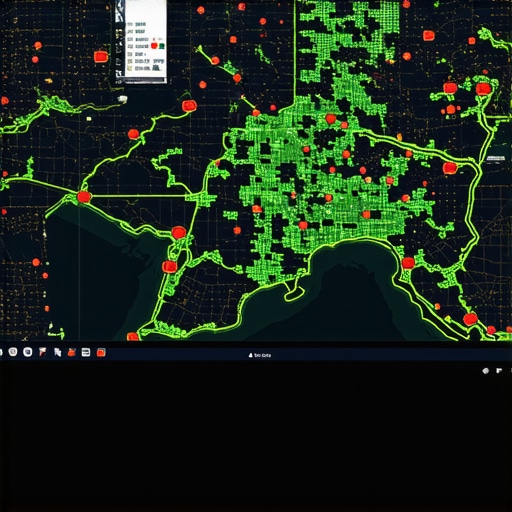
Stop relying on manual searches from your office desk to check your rank. It’s a lie. Because of the proximity filter, you’ll always look like a king in your own parking lot. I personally use grid tracking tools like Local Falcon or Places Scout because they provide a heat map of your visibility across the entire city. I use these specifically because they reveal the ‘blooms’ of your authority. If I see a cluster of red dots (ranking #10+) in a high-value neighborhood just five miles away, I don’t guess—I know exactly where I need to deploy my next localized content piece or customer photo request. This is the foundation of a real local mapping strategy. Without a grid view, you are flying a plane without a dashboard. To get a better handle on your current standing, you should how to audit your local competitors without expensive tools to see where they are out-positioning your current reach.
How do I keep my map position steady month after month?
Maintenance is about velocity, not just volume. Google looks for a steady heartbeat. I’ve found that a business getting two reviews a week, every week, will almost always outrank a business that gets 50 reviews in one day and then goes silent for a month. This is the review frequency secret for long-term map dominance. You need to create a system where your team is triggered to ask for feedback the moment the job is done. But it’s not just about the reviews themselves; it’s about what you do with them. I make it a point to respond to every single review within 12 hours. Why? Because how response speed directly impacts your local map authority is a factor that Google is weighing more heavily as they prioritize ‘active’ businesses. If you are slow to engage, Google assumes you are slow to serve customers, and they will demote you accordingly.
Stop Treating Your Profile Like a Static Billboard
The future of local maps domination is moving toward ‘Real-World Signals.’ Mike Blumenthal, a renowned expert in the local search space, has often noted that Google is increasingly using AI to verify if a business is actually ‘busy’ and ‘relevant’ based on user interaction data. This means your ‘Open Now’ status and your interaction rate through the messaging feature are becoming massive signals. If you want to how to secure your spot in the map pack permanently, you have to treat your profile like a social media feed. Post updates at least twice a week. These don’t have to be Shakespearean; they just need to prove you are open for business and solving problems today. If you’ve been neglecting your profile’s ‘heartbeat,’ my challenge to you is simple: go into your dashboard right now and respond to your three oldest unanswered reviews. That one small act of engagement sends a fresh ‘ping’ to the algorithm that you’re back in the game.
The Hard Truths I Learned While Chasing the Map Pack
When I first started obsessing over my position in the local results, I fell for the biggest lie in the industry: that you can set it and forget it. I spent months building a profile I thought was perfect, only to watch a competitor with fewer reviews leapfrog me because they understood the nuances of local mapping strategy better than I did. One major lightbulb moment was realizing that review velocity is far more important than raw numbers. If you want to sustain your the review frequency secret for long-term map dominance, you have to keep the algorithm fed with constant, fresh signals rather than trying to buy a hundred reviews in a weekend. I also learned that if your site feels sluggish, it’s not just annoying your visitors—it’s actively pushing you off the map. I’ve seen firsthand why your website speed is secretly tanking your map rank, and fixing that was one of the single biggest needle-movers for my visibility.
The Tools I Use to Keep an Eye on the Competition
I don’t believe in flying blind. To win at this game, you need data that shows you what’s happening three miles away from your desk. I personally rely on grid tracking tools because they strip away the bias of my own location and show me exactly where my authority starts to fade. If you aren’t sure where to start, you should learn how to audit your local competitors without expensive tools. This allows you to see if their edge comes from better categories, more relevant photos, or simply a tighter connection between their site and their map profile. I also trust resources like Whitespark and Local Falcon because they provide the technical depth needed to turn a struggling profile into a powerhouse. These aren’t just toys; they are the radar systems for your local maps domination journey.
Your Blueprint for Local Dominance Starts Today
The invisible walls of the proximity filter only exist as long as you let them. By consistently feeding Google the real-world proof it craves—through neighborhood mentions, fast response times, and high-quality customer photos—you can expand your reach further than you ever thought possible. Don’t let a zip code define your business’s growth. It’s time to take control and learn how to secure your spot in the map pack permanently. Your future customers are searching for you right now; make sure you’re the first thing they see. Have you noticed your ranking drop the second you leave your office parking lot? Let me know below and let’s troubleshoot it together.
About the Author
Umar Latif
Brand & Marketing Expert · Dubai, UAE
Umar Latif is a seasoned Brand and Marketing Expert based in Dubai, UAE, with a specialized focus on Local SEO and international digital strategy. With extensive experience managing and optimizing websites for a diverse range of international clients, including those in the United States, Umar has developed a deep understanding of the nuances required to dominate local search results. His technical proficiency encompasses comprehensive keyword research and the implementation of advanced Google-centric strategies designed to enhance visibility and drive organic traffic. As a contributor to dominateyourlocalmaps.com, Umar leverages his background in global marketing to provide actionable insights for businesses looking to improve their local map rankings and digital footprint. His approach combines data-driven tactics with a strategic brand perspective, ensuring that local businesses not only rank higher but also resonate with their target audience. Throughout his career, Umar has remained dedicated to staying ahead of search engine algorithm changes to deliver consistent results for his clients. He is deeply passionate about empowering business owners and marketing professionals with the tools and knowledge they need to achieve sustainable growth.