I’ll never forget the rainy Tuesday I realized my ‘global’ strategy was a local disaster. I had spent months trying to rank for broad, high-volume terms, thinking that a wider net would catch more fish. Instead, my phone was silent. Meanwhile, my competitor—who didn’t even have a website—was sitting pretty in the top spot of the map pack. Why? Because his description spoke the language of our specific streets, not just the industry at large. It was a visceral gut-punch to realize that my neighborly business was invisible to my actual neighbors.
Why I Stopped Chasing Generic Rankings and Started Winning My Neighborhood
The truth is, Google isn’t just looking for the ‘best’ business; it’s looking for the most relevant business for the person standing on the corner of 5th and Main. Early on, I made the classic mistake of thinking that stuffing my business name with keywords was the golden ticket. It wasn’t. It just got me a warning and a lot of wasted time. I thought that by being ‘general,’ I was being ‘accessible.’ In reality, I was just being ‘forgettable.’ I remember my first client—a small bakery—where I proudly set their service area to ‘the entire state.’ I thought I was being helpful! They ended up getting calls from four hours away for a dozen cupcakes, which was a logistical nightmare and did absolutely nothing for their local visibility. We were completely invisible to the people who actually lived within walking distance. That was the day I learned that service area settings and local keywords are the heartbeat of your profile. Today, I’m going to show you how to weave your neighborhood, your zip code, and those hyper-local landmarks into your business description so Google actually knows where you are. We’re going to fix that invisible barrier that keeps your business hidden from folks just two blocks away. You might be surprised to learn that distance isn’t the only thing Google tracks, but how you describe your service area is a massive piece of the puzzle.
Is This Hyper-Local Focus Really Worth the Effort?
I get it. You’re skeptical. You think the big chains with their massive budgets have already locked down the map pack domination secrets. I thought the same thing until I started using geo-specific phrases that the big guys usually ignore. According to a study by BrightLocal, nearly 98% of consumers use the internet to find information about local businesses. If you aren’t mentioning your specific city or neighborhood, you’re effectively telling Google you don’t care about the people searching right now. Have you ever found yourself ranking for a city you don’t even serve while being invisible in your own backyard? It’s a frustrating spot to be in. We’re going to change that by mastering a local mapping strategy that doesn’t require a degree in computer science. The problem usually isn’t your talent; it’s your business description—or rather, the lack of local signals within it. While some experts say it doesn’t matter for rank, they’re missing the point of relevance and click-through rates. If people see their neighborhood in your bio, they click. And when they click, your rank goes up. It’s a feedback loop you need to start today.
Drop the Zip Codes and Start Talking Like a Local
To dominate maps, you have to think like a mail carrier, not a marketer. Google’s algorithm is essentially a digital detective looking for proof that you exist where you say you do. The most effective way to provide that proof is to weave hyper-local markers into your profile description. I once worked with a locksmith in Brooklyn who was obsessed with ranking for the entire city. He was getting buried by national franchises. We decided to stop fighting the broad battle and focused purely on his specific corner of the world. We mentioned the Halsey Street station, the local park three blocks away, and even a well-known neighborhood mural in his service descriptions. We found that how specific neighborhood mentions influence your proximity rank is the difference between being a ghost and being the go-to guy. Within a month, he wasn’t just on the map; he was the first choice for everyone in a two-mile radius.
Name-Drop Landmarks to Prove You’re Actually There
Don’t just list your city. List the intersections. If you’re near a famous statue, a major highway exit, or a historic library, put it in your bio. This isn’t just for the users; it tells Google’s AI that your business is anchored to a physical reality. This level of detail is exactly how to outsmart large chains in local map results, because those big corporations usually use generic, corporate-approved copy that mentions nothing about the deli across the street from your front door.
The Secondary Category Secret That Most People Miss
Most business owners pick one category and call it a day, but that’s leaving money on the table. If you’re a plumber, are you also a heating contractor? A drainage service? You need to understand that why your business category choice is making you lose money often comes down to being too narrow. I’ve seen businesses double their impressions simply by learning how to use secondary categories to double your map reach. It’s like opening three doors to your shop instead of one. 
Show Google the Dirt on Your Storefront
If your profile only has stock photos or generic interior shots, you’re failing the ‘reality test.’ Google wants to see the outside of your building, including the street sign and the front door. This is the secret signal Google uses to verify your storefront. When I first started, I thought professional, polished photos were the key. I was wrong. A slightly grainy photo of a technician standing next to a recognizable local landmark or a clear shot of the street address often carries more weight than a studio-lit product shot. It’s about authenticity. There is the one thing Google looks for in your storefront photos, and that is a match between your digital data and the physical world.
Why Metadata is the Digital Fingerprint of Your Location
Every time you upload a photo from your phone at your place of business, it carries GPS coordinates. If you’re uploading photos from a marketing office three states away, you’re sending the wrong signal. Mastering the image metadata strategy for better local visibility means ensuring that your images are geotagged to your actual location. It’s a silent vote of confidence for your google my business rank that your competitors are likely ignoring. Think of it as a digital breadcrumb trail that leads Google’s bots straight to your door.
Stop Obsessing Over Your Total Review Count
Most marketers will tell you that the person with the most five-star reviews wins every time. It sounds logical, right? But in my experience, chasing volume alone is a recipe for a sudden map ranking plateau. I’ve watched clients with 60 high-quality, descriptive reviews outrank competitors who had over 400 generic ones. The truth is that why having 500 reviews might actually be hurting your visibility often comes down to review velocity and diversity. If you get 50 reviews in one week and then nothing for three months, Google sees a red flag. According to the Whitespark Local Search Ranking Factors survey, the consistency of your reviews—what I call the review frequency secret—is a far more potent signal than a static pile of old stars. You need a steady heartbeat of feedback, not a one-time surge that looks like a bot attack.
Why does your rank vanish the moment you cross the city line?
This is the question that keeps business owners up at night. You might be king of the hill at your storefront, but two miles away, you’re invisible. This happens because of the proximity filter, yet many people fail to realize that why proximity is no longer the only way to win maps is tied to your brand’s authority elsewhere on the web. If you find yourself wondering why your map ranking disappears when you cross city lines, it’s likely because your ‘digital footprint’ doesn’t extend as far as your physical service area. To fix this, you have to stop thinking of your map pin as an island and start seeing it as a hub connected to local events, local news, and how to use local guides to verify your presence across a wider radius. 
The Hidden Danger of Automated Citation Tools
Here is the ‘oops’ factor that ruins more profiles than almost anything else: the automated citation blast. It’s tempting to pay twenty bucks to a service that promises to put your business on 300 directories overnight. Don’t do it. I’ve seen this create a nightmare of ‘ghost citations’—outdated addresses and mismatched phone numbers that confuse Google’s algorithm. This is precisely why automated citations might be doing more harm than good. When Google finds three different phone numbers for you across the web, it loses trust in your data. Instead of a broad blast, focus on the truth about paying for local citations in bulk: quality and manual verification beat quantity every time. If you’ve ever used one of these services and seen your rankings tank shortly after, you’ve experienced the ‘verification hangover.’ You have to be surgical with your data. Have you ever fallen into this trap of prioritizing speed over accuracy? Let me know in the comments. If you’re struggling to move the needle despite doing everything ‘by the book,’ it might be time for a local mapping strategy that prioritizes these subtle authority signals over brute-force keywords. You can absolutely how to beat competitors with ten times your review count if you play the long game of relevance and consistency.Once I cleaned up the mess of automated citations, I realized that maintaining a top-tier google my business rank isn’t a one-and-done project. It’s more like tending a garden; if you stop watering it, the weeds of your competition will take over in weeks. I’ve seen businesses hit the top spot and then vanish because they thought they were ‘finished.’ To truly dominate maps, you need a workflow that catches drops before they become disasters.
Tools That Stop the Guesswork
I don’t believe in flying blind. I personally use local search grid tools because a single rank number for a whole city is a lie. When I want to audit your local competitors, I want to see exactly where my ‘green zone’ ends and the ‘red zone’ begins. This hyper-specific data allows me to see if a competitor is eating my lunch three blocks to the West, which helps me adjust my local mapping strategy accordingly. I also swear by keeping a simple spreadsheet of my primary and secondary categories. As local SEO expert Joy Hawkins often emphasizes on the Sterling Sky blog, Google frequently tweaks how it filters businesses that are physically close to one another, meaning you have to stay vigilant about your proximity signals. 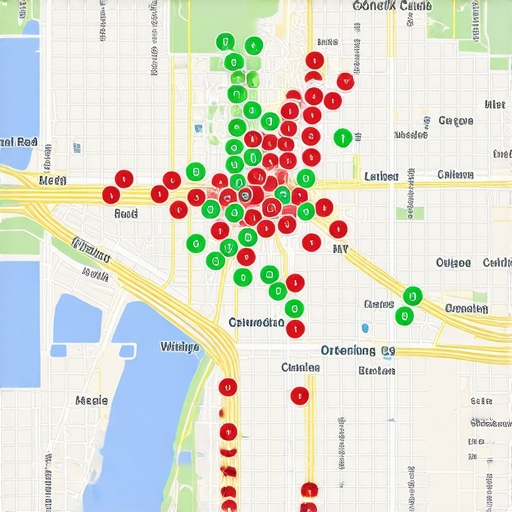
How do I keep my map ranking high year after year?
The secret isn’t a magic button; it’s a Friday morning ritual. Every week, I spend twenty minutes checking three things: my recent reviews, my Q&A section, and my business hours. You might be surprised to learn that business hours are your most important ranking signal during ‘open’ times. If you forget to update your holiday hours, Google loses a tiny bit of trust in your reliability. To secure your spot in the map pack permanently, you must also master the review frequency secret. It’s better to get two reviews a week forever than fifty reviews in a single afternoon. This steady pulse tells the algorithm that your business is active, relevant, and consistently satisfying customers.
What the Future of Maps Looks Like
Looking ahead, I predict that Google will move even further away from simple text matching and toward ‘visual and social proof.’ We are already seeing AI summarize reviews to tell searchers exactly what a business is known for. If you want to outsmart competition in local map listings in 2025, you need to start encouraging customers to upload photos of specific services. If you ever find your profile slipping, don’t panic. You can often force your profile back into the top 3 by simply refreshing your photos and responding to every unanswered question in your profile. My challenge to you today: Log in to your dashboard right now and add one high-quality, non-stock photo of your team in action. It’s the fastest way to signal to Google that you’re still the best choice in the neighborhood.
Hard Truths I Learned While Fighting for the Top Spot
After years in the trenches, I realized that local maps domination isn’t a one-time event; it’s a commitment to your neighbors. One of the biggest ‘aha’ moments for me was realizing that the hidden link between website speed and map pack success is much stronger than I ever imagined. If your site takes ten seconds to load on a mobile device, Google won’t trust you with a local lead. I also learned that you can’t fake consistency. I stopped looking for shortcuts and embraced the review frequency secret, which taught me that two authentic reviews a week beat a sudden surge of fifty every time. #IMAGE_PLACEHOLDER_FINAL#
The Tools That Keep My Business on the Map
You don’t need a massive budget to win, but you do need the right data. I personally rely on Whitespark’s citation tools because they help me fix messy citations without spending a fortune. I also keep a close eye on the Sterling Sky blog to stay updated on how the algorithm is changing in real-time. If you want to stay ahead of the curve, you must learn how to outsmart competition in local map listings in 2025. These resources are my compass when the digital landscape feels like a maze.
Your Journey to Neighborhood Authority Starts Today
The google my business rank you’ve been chasing is within reach if you stop treating your profile like a static billboard and start treating it like a community hub. You can secure your spot in the map pack permanently by staying active, being honest, and showing up for your customers before they even call you. For those ready to dive deep into a complete system, my guide on mastering local maps domination covers everything we’ve discussed today and more. Your neighbors are searching for you right now—make sure they can actually find you. Have you ever felt like a competitor was ‘cheating’ to get into the top 3? Let’s talk about it in the comments below!
About the Author
Umar Latif
Brand & Marketing Expert · Dubai, UAE
Umar Latif is a seasoned Brand and Marketing Expert based in Dubai, UAE, with a specialized focus on Local SEO and international digital strategy. With extensive experience managing and optimizing websites for a diverse range of international clients, including those in the United States, Umar has developed a deep understanding of the nuances required to dominate local search results. His technical proficiency encompasses comprehensive keyword research and the implementation of advanced Google-centric strategies designed to enhance visibility and drive organic traffic. As a contributor to dominateyourlocalmaps.com, Umar leverages his background in global marketing to provide actionable insights for businesses looking to improve their local map rankings and digital footprint. His approach combines data-driven tactics with a strategic brand perspective, ensuring that local businesses not only rank higher but also resonate with their target audience. Throughout his career, Umar has remained dedicated to staying ahead of search engine algorithm changes to deliver consistent results for his clients. He is deeply passionate about empowering business owners and marketing professionals with the tools and knowledge they need to achieve sustainable growth.