I remember sitting in my truck three years ago, watching a notification for a lead pop up on my phone while I was eating a sandwich. I told myself I’d get to it after I finished my lunch. That small, twenty-minute delay didn’t just lose me a client; it caused my profile to slide down the rankings. It was a wake-up call. I realized that Google tracks how fast we engage, and if we are slow, they simply stop showing us to people who need help right now.
Stop treating your notifications like junk mail
My biggest screw-up early on was thinking that “good enough” was good enough. I assumed that as long as I eventually replied, I was doing my job. I was wrong. Google’s algorithm is essentially a matchmaker, and it doesn’t want to set its users up with someone who is going to leave them on read. When you ignore a message or a review, you’re telling the system that you aren’t open for business. If you want to force your profile back into the top 3 results, you have to start valuing the hidden impact of review response speed on map ranking. It isn’t just about being polite; it’s about proving to the algorithm that your business is active and reliable.
Is the five-minute rule actually worth the hype?
You might be skeptical. You have a business to run, after all. But consider this: a landmark study by the Harvard Business Review found that businesses that respond to leads within an hour are seven times more likely to qualify that lead than those who wait even sixty minutes. Google knows this. They track the “time to first response” through their messaging platform and even use your specific review response patterns to gauge your authority. Have you ever felt like you’re doing everything right with your SEO but still losing out to the guy down the street who answers his phone on the first ring? I’ve been there, and I know how frustrating it is to see your map pack domination dreams stall because of a few missed pings. Today, we’re going to look at why that happens and how you can flip the script to make speed your biggest competitive advantage.
Fix your categories before the algorithm gets confused
If you want to see a real move in your google my business rank, you have to look at the structural integrity of your profile first. I once worked with a locksmith who had 150 five-star reviews but was nowhere to be found in the map pack. After digging in, I realized he had set his primary category to ‘Security Consultant.’ To us, it sounds professional, but to Google, it meant he wasn’t a local service provider for people locked out of their cars. We swapped his primary category to ‘Locksmith,’ and within 72 hours, his profile shot from page three to the number two spot. This happens more often than you think because your business categories might be fighting each other if they are too broad or conflicting.
Stop guessing and use the data
Most people pick categories that sound right to them, but you need to stop guessing your categories and use selection data based on what the top-ranking competitors are actually using. If the top three guys in your city for ‘HVAC repair’ are all using ‘Air Conditioning Contractor’ as their primary, don’t try to be different by choosing ‘Heating Contractor’ just to stand out. Google rewards relevance over uniqueness every single time in the map pack.
The interaction signal is your secret weapon
Once your categories are straight, you need to prove to Google that people actually like your business. This is what the pros call ‘behavioral signals.’ Every time someone clicks your ‘Call’ button, asks for directions, or stays on your profile for more than thirty seconds, they are voting for you. This is the interaction data that proves you are a top local choice. I remember testing this with a small coffee shop. We started encouraging customers to upload photos of their lattes directly to the profile while they were waiting. That surge in user-uploaded content didn’t just look good; it told the algorithm the business was a high-traffic hub. You can effectively leverage user-generated content for map domination by making it part of your daily operation.
Visuals carry more weight than your description
Your business description is for customers, but your photos are for the robots. Google uses AI to scan your images for objects, text, and even landmarks to verify where you are. If you aren’t using the specific photo metadata that actually moves your map rank, you’re leaving money on the table. Every photo you upload should be a clear representation of your service in action, not just a generic stock photo from the internet.
How to win when you’re technically outside the city center
Proximity is the hardest hurdle to clear, but it’s not impossible. If your shop is five miles away from the ‘center’ of the city, Google naturally wants to show the closer guy first. However, you can beat the proximity filter and expand your reach by focusing on hyper-local signals. This means creating content and getting reviews from the specific neighborhoods you want to target. When a customer in a neighboring town leaves a review mentioning their specific zip code or street name, it tells Google your local mapping strategy is relevant to that area too. This is how you achieve true map pack domination even when you aren’t the closest option geographically.Let’s dig deeper into what actually moves the needle when you are trying to dominate maps. Everyone tells you to hunt for five-star reviews like they are gold coins, but I have seen businesses with hundreds of glowing testimonials get absolutely crushed by a competitor with a fraction of that count. This is because quantity is a vanity metric that hides the real data Google is looking for. If you have ever wondered why your competitor ranks higher with 10 fewer reviews, it is likely because their reviews are rich in specific service-level keywords and semantic relevance. You could be suffering from the invisible profile where you have the stars, but none of the authority.
Quantity is a vanity metric that hides the real data
In my experience, most business owners focus on the number at the top of their profile while ignoring the substance underneath. Google’s NLP (Natural Language Processing) is reading every single word your customers write. If your reviews are all generic ‘Great job!’ or ‘Highly recommend,’ they don’t help your google my business rank nearly as much as a review that says, ‘They fixed my leaking pipe in downtown Chicago within two hours.’ This is the logic behind the specific review keywords that trigger map visibility. If you aren’t encouraging your clients to mention the specific service or neighborhood, you are leaving your local mapping strategy to chance. #IMAGE_PLACE_HOLDER_C#
Avoid the suspension trap when updating your info
There is a specific ‘Oops’ factor that I see kill momentum more than anything else: the impulsive profile edit. I have seen contractors get frustrated with their rank and decide to change their business name or primary category on a Tuesday afternoon, only to find their profile suspended by Wednesday morning. This is the real reason your profile was suspended after an edit. Google is incredibly sensitive to major changes in core data because that is how scammers operate. If you don’t have the right documentation ready, like the one document that reinstates any google business profile, you could be out of the game for weeks while you wait for a manual review.
Why do some businesses rank higher with fewer reviews?
It often comes down to what experts call ‘Review Diversity’ and ‘Topic Authority.’ According to the Whitespark Local Search Ranking Factors, the presence of high-volume keywords in your reviews is one of the top signals for the map pack. This is why a law firm might struggle to get into the top 3 even with a high rating. If you want to fix this, you need to identify the one thing keeping your law firm out of the local pack, which is usually a lack of topical depth in your customer feedback. Have you ever fallen into this trap of chasing quantity over quality? Let me know in the comments. Moving forward, we need to talk about how to protect the ground you have already gained while expanding your reach into neighboring zip codes without getting flagged.Once you’ve clawed your way into the top three, the real work begins—and no, it’s not just more of the same. I’ve seen business owners hit number one and then disappear a month later because they thought the job was done. You need to understand the power of regular profile updates on search frequency if you want to stay relevant. I treat my profile like a digital storefront; if I haven’t ‘swept the floors’ or changed the ‘window display’ through new photos and posts in two weeks, the algorithm starts to think I’ve gone dormant. To keep tabs on this, you need to learn how to audit your map rankings from a customers real location rather than just searching from your office desk. I personally use geo-grid tools because they show me exactly where my ‘bubble’ of influence ends and where I need to push harder.
Boot the fakes off your turf
You aren’t just fighting the algorithm; you’re fighting people who cheat. I spend about thirty minutes every Friday morning hunting for ‘ghost’ businesses. These are listings with keyword-stuffed names like ‘Best Plumber Chicago #1’ that don’t actually exist at the address listed. You can effectively learn how to remove fraudulent competitor listings that push you down by using the ‘Suggest an edit’ feature properly. It’s one of the most satisfying parts of a local mapping strategy—watching a fake listing vanish and seeing your own profile jump up a spot instantly. 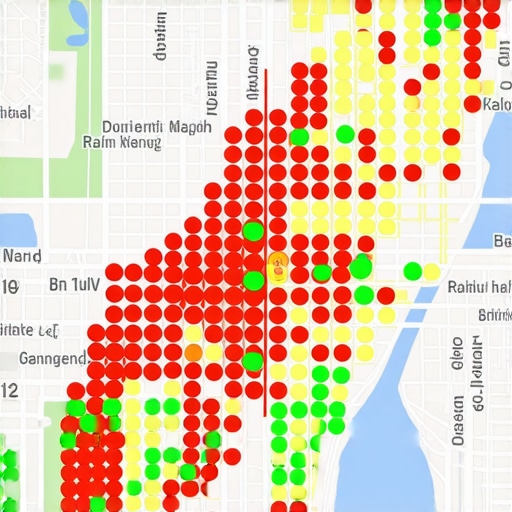
How do I keep my map rank steady over the long haul?
The secret isn’t a magic button; it’s a routine. I focus on three things: fresh visual content, responding to every single interaction, and monitoring public edits. If you ignore a 1-star review, you’re missing a chance to stabilize your rank. You need to master the exact way to response to 1-star reviews without losing rank to show Google you are a responsible and active owner. As Joy Hawkins from Sterling Sky has frequently highlighted in her research on the ‘Vicinity’ update, Google has become much more aggressive about filtering out businesses that don’t maintain a clean and honest profile. This means your maintenance must include checking that your NAP data hasn’t been corrupted by third-party aggregators.
The future of local search is moving toward intent
Looking ahead, I predict that ‘keywords’ will matter even less than they do now, and ‘context’ will matter more. Google is already getting better at understanding the nuance of a search like ‘where can I get a quiet coffee’ versus ‘best espresso near me.’ This is why you need to how to optimize your business profile for voice search map results right now. The AI is looking for conversational clues in your Q&A section and your posts to match you with those specific, long-tail queries. My big challenge for you today is this: go look at your ‘Foot Traffic’ or ‘Popular Times’ data in your dashboard. Most people ignore it, but understanding how real foot traffic data overpowers on page SEO is becoming a massive factor in map pack domination. If you can prove people are physically visiting your location, your google my business rank becomes significantly more stable.#IMAGE_PLACEHOLDER_E#
The Brutal Truth I Learned After 500 Profile Audits
Looking back at the thousands of profiles I’ve analyzed, the biggest differentiator isn’t a secret piece of code; it’s relentless consistency. I’ve seen businesses shoot to the top using my ultimate guide to google my business rank elevation, only to fall back because they stopped updating their photos for three months. Another hard lesson? Proximity is a filter, not a death sentence. You can actually extend your reach if you know how to audit your map rankings from a customers real location rather than just checking your rank from your own office chair. Most owners forget that Google sees the world differently depending on which street corner the searcher is standing on.
The Arsenal You Need to Stay on Top
I don’t believe in bloated software, but there are a few resources that are non-negotiable for a winning local mapping strategy. I always keep an eye on Whitespark for citation health—but be careful, because you should stop wasting cash on local citations that google ignores and focus only on those that carry real authority in 2025. For algorithm shifts, the research coming out of Sterling Sky is my go-to for factual, data-driven updates. Lastly, I use geo-grid trackers to visualize my map pack domination across the entire city, ensuring there are no dead zones where my competitors are sneaking in.
Your First Step Toward the Top Three
The road to local maps domination isn’t a sprint; it’s a series of intentional moves that build authority over time. You don’t need to fix everything tonight. Start by verifying your categories, then move to your response speed, and finally, focus on high-quality visual data. If you stay the course, you will eventually how to outsmart competition in local map listings in 2025 and secure the leads your business deserves. What’s the one biggest hurdle currently stopping you from hitting that top 3 spot? Let me know in the comments below!
About the Author
Umar Latif
Brand & Marketing Expert · Dubai, UAE
Umar Latif is a seasoned Brand and Marketing Expert based in Dubai, UAE, with a specialized focus on Local SEO and international digital strategy. With extensive experience managing and optimizing websites for a diverse range of international clients, including those in the United States, Umar has developed a deep understanding of the nuances required to dominate local search results. His technical proficiency encompasses comprehensive keyword research and the implementation of advanced Google-centric strategies designed to enhance visibility and drive organic traffic. As a contributor to dominateyourlocalmaps.com, Umar leverages his background in global marketing to provide actionable insights for businesses looking to improve their local map rankings and digital footprint. His approach combines data-driven tactics with a strategic brand perspective, ensuring that local businesses not only rank higher but also resonate with their target audience. Throughout his career, Umar has remained dedicated to staying ahead of search engine algorithm changes to deliver consistent results for his clients. He is deeply passionate about empowering business owners and marketing professionals with the tools and knowledge they need to achieve sustainable growth.