I’ll never forget the Tuesday morning I decided to “clean up” my service area. I was feeling productive, coffee in hand, ready to finally achieve some mastering local maps domination. I changed three zip codes and hit save. Then, I waited. And waited. Three weeks later, that little orange “Pending” badge was still staring back at me. It felt like shouting into a void where nobody listens. My phone stopped ringing because my hours looked “unverified” to potential customers. I had made a classic mistake: I assumed Google trusted me just because I owned the business. I was wrong. If you’re stuck in this digital purgatory right now, I promise you aren’t alone, and there is a very specific way out of this mess that doesn’t involve screaming at a chatbot.
Why Google Keeps Your Edits in Limbo
The truth is, Google’s trust levels are at an all-time low. They aren’t just being difficult; they are fighting a massive wave of spam and “ghost” businesses. When you change a phone number or a category, you’re often triggering an automated trust filter. I learned the hard way that why your profile edits keep getting rejected often boils down to a lack of “offline proof.” Early in my career, I thought I could just update my address to a co-working space without any documentation. That move didn’t just get my edit pending; it nearly got me suspended. Google wants to see that your digital footprint matches the real world perfectly. If there is a mismatch between your website and your profile, the system pauses everything. This stagnation kills your momentum and allows others to dominate maps in your territory.
Does Google really care about my business hours?
It might feel like micro-management, but to the algorithm, accuracy is the only currency. According to recent data from Search Engine Journal, Google has significantly ramped up AI-driven moderation, which can lead to “false positives” where legitimate business owners get caught in the filter. This is why your google my business rank can suddenly tank while your edits are stuck; the system sees an inconsistency and hits the brakes on your visibility. It is a defensive mechanism. Have you ever felt like your profile was stuck in a loop of endless waiting while your competitors sailed right past you? It’s infuriating to watch your map pack domination dreams slip away because of a software glitch or a verification lag.
The Trust Gap You Didn’t Know Existed
We often talk about keywords and photos, but the real driver of local success is deep-rooted trust. When your edits stay pending, it’s a signal that Google doesn’t quite believe you are who you say you are at this very moment. This usually happens because your data elsewhere on the web—like your website or old directory listings—doesn’t match the new “truth” you’re trying to push. It’s frustrating, sure, but once you understand that Google is essentially a giant fact-checker, you can start providing the “proof” they crave before they even ask for it. I wasted months trying to “force” edits through by clicking the save button over and over. Don’t do that. It just flags your account for suspicious activity. Instead, we need to look at your local mapping strategy from the perspective of an auditor. Once you start feeding the machine the right signals, those “Pending” tags disappear faster than you’d think. Let’s look at how we can bridge that gap and get those changes live today.
Scrub Your Digital Footprint to Build Immediate Trust
Google acts like a hyper-fixated private investigator. Before it approves that ‘Pending’ edit, it cross-references every corner of the internet to see if you are telling the truth. I once spent two agonizing months fighting for a plumber in Austin whose address change just wouldn’t stick. We eventually found the culprit: a 2014 Yelp listing he didn’t even know existed, showing a different suite number. To achieve mastering local maps domination, you must first how to spot and fix nap inconsistencies without paying monthly fees. If your website says ‘Suite A’ but your profile says ‘Ste A’, you’re creating a friction point for the algorithm. These tiny cracks in your data armor are exactly why your google my business rank starts to wobble. Google doesn’t guess; it verifies, and if the data is messy, the ‘Pending’ status is its way of saying it doesn’t trust you yet.
Collect Your Receipts Before the Audit Happens
You need to stop viewing your profile as a static billboard and start seeing it as a living document that requires constant proof of life. When an edit hangs in limbo, it’s usually because you haven’t provided enough ‘offline’ context for the system to feel comfortable. This is the core of why your profile edits keep getting rejected and the proof google wants. Google loves high-resolution photos of your permanent signage, not just stock images or interior shots of a desk.
Show the Algorithm Your Front Door
Upload a photo of your front door with the street number and your business logo clearly visible in the same frame. It’s a simple move, but it’s one of those 4 image tweaks that stop searchers from scrolling past your listing that also signals legitimacy to the AI auditors. This physical proof acts as a digital anchor for your location.
Turn Real Human Movement into Your Best Verification Tool
In the world of map pack domination, GPS data is king. If the system sees that zero mobile phones are actually traveling to your physical location, it assumes you’re a ‘ghost’ business or a lead-gen trap. This is where how real foot traffic signals fix a stalled google my business rank becomes your secret weapon. When I had a client stuck in verification limbo, we encouraged their regular customers to open the Google Maps app while standing in the shop to check in or leave a photo. Those pings are undeniable proof that your business is a real, breathing entity.
Force a Re-Evaluation of Your Authority
If you want to dominate maps, you have to feed the algorithm fresh, location-based data. Try these 5 fast signal tweaks that actually improve your google my business rank, like responding to reviews with specific neighborhood mentions and uploading ‘behind the scenes’ photos weekly. It bridges the gap between your digital claims and the physical reality of your service area. This is the hidden move that secures map pack domination for small shops: proving you are the most relevant local choice through consistent, localized interaction.
Audit Your Map Coverage Like a Pro
Most owners look at their rankings from their own desk, which is a massive mistake because Google knows your device is at that exact coordinate. You need to see how you appear to a customer three miles away at a coffee shop or a park. Using innovative local mapping strategies means testing your visibility from multiple points in the city. If your rank drops off the second someone crosses a certain boulevard, you’ve found your ‘trust boundary’ that needs to be pushed outward through better localized content and real-world signals.While we’re on the subject of auditing, let’s talk about the biggest lie in the local SEO world: the idea that more reviews always equals a better rank. Everyone says you need to be the business with the most stars, but in my experience, why nearby competitors beat you in maps with fewer reviews often comes down to the quality and frequency of interaction, not just the raw quantity. Have you ever fallen into this trap? Let me know in the comments. I’ve seen businesses with 400 reviews get buried by a competitor with 40 because the smaller shop has better review velocity and more keyword-rich descriptions from their real customers.
Stop chasing review counts like they’re the only thing that matters
According to the 2023 Local Search Ranking Factors study by Whitespark, the diversity of keywords in reviews and the speed at which you respond are actually more critical for mastering local maps domination than just hitting a big number. If you’re getting 10 reviews in one day and then nothing for a month, Google sees that as a red flag. It looks like a review blast rather than organic growth. You want a steady, natural drip to maintain your google my business rank.
The category trap that dilutes your local authority
Another nuance most people miss is the danger of being a jack of all trades on your profile. I see this all the time with home service contractors. They select Plumber, HVAC, Electrician, and Handyman all on one profile. This is why most business owners pick the wrong categories and kill their local map rank. By spreading yourself too thin, you’re diluting the primary signal. If Google’s AI is only 20% sure you are a plumber, it won’t put you in the top 3 when a pipe bursts. You need to pick one heavy-hitting primary category and let the others be strictly secondary. This mistake makes your profile effectively invisible for the high-value jobs you actually want.
Can real-world movement actually override your digital SEO?
This is the hidden nuance that separates the pros from the amateurs. You can have the best keywords in the world, but if the GPS data doesn’t back it up, you’ll never achieve true map pack domination. Google is tracking store visits even if users don’t check in. When a customer’s phone moves toward your location and stays there for 30 minutes, that is the interaction data that proves you are a top local choice.  This is exactly how real foot traffic signals fix a stalled google my business rank. If your physical office is just a shell and nobody ever goes there, the algorithm eventually figures it out. It’s why innovative local mapping strategies now focus more on getting people to actually visit your pin than just clicking your link. You want to dominate maps by being a physical destination, not just a digital search result.
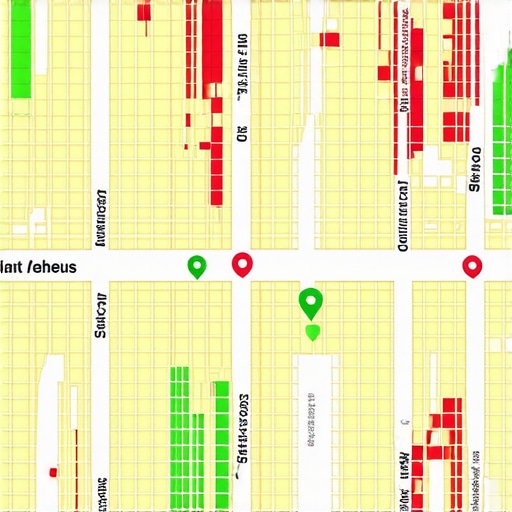
I’ve realized that mastering local maps domination isn’t a one-and-done trophy you put on a shelf; it is more like maintaining a high-performance engine. If you stop changing the oil, the friction eventually wins. To keep your edge, you need a toolkit that moves beyond the basic Google interface. I personally swear by Local Falcon for grid tracking. Why? Because looking at a single ranking from your office desk is the biggest lie in SEO. It doesn’t tell you that you’ve disappeared two blocks away. By using a grid-based local mapping strategy, I can see exactly where the ‘ranking cliff’ is. This allows me to focus my efforts on specific neighborhoods rather than shouting at the whole city. If you aren’t sure where your cliff is, you’re likely falling victim to the audit mistake that makes your map listing effectively invisible.
Stop guessing where you rank and start tracking the grid
I remember a client who was convinced they were number one in the city. When we ran a 13×13 grid search, we found they were only number one for the three blocks surrounding their building. Everywhere else, they were buried on page two. To fix this, we stopped obsessing over the broad term and started looking at the hidden power of store attributes in map pack selection. We toggled on every relevant, verified attribute—from ‘Identifies as women-led’ to ‘Wheelchair accessible entrance.’ These aren’t just labels; they are filters that Google uses to match intent. When you get granular, you start to see the hidden power of store attributes in map pack selection in action. It’s about being the most specific answer, not just the loudest one.
How do I keep my rank from slipping as competitors wake up?
Consistency is your only defense against the ‘new guy’ syndrome. I’ve seen brand-new shops burst onto the scene with a google my business rank that defies logic, only to vanish ninety days later. This happens because they had a ‘burst’ of activity that Google eventually flagged as unnatural. As noted by local search expert Mike Blumenthal, Google is increasingly acting as the ‘new homepage’ for businesses, meaning the data on your profile must be fresher than the data on your website. I recommend a ‘Friday Five’ routine: five minutes to respond to reviews, five minutes to upload one real-world photo, and five minutes to check for ‘suggested edits’ from the public. This prevents the decay described in why most businesses fail to hold a top spot in the map pack after three months. When you maintain that steady heartbeat of data, the algorithm views you as a reliable, active destination.
Looking ahead to 2026, I predict that Google will rely almost exclusively on ‘Zero-Click’ verification. This means your map pack domination will depend on how many people interact with your profile without ever visiting your website. They will look at how long people linger on your photos and whether they click your ‘Call’ button within seconds of seeing your profile. This is why you must close the call button gap immediately. If you want to see where your profile stands before the next update hits, I challenge you to run a quick 10-minute local seo audit that uncovers why your rankings stalled. It’s the fastest way to find the leaks in your local boat before you start sinking in the rankings.
What the AI Auditors Taught Me About Digital Trust
The biggest lightbulb moment in my career happened when I realized that Google isn’t a search engine; it is a giant, skeptical fact-checker. I used to think I could trick the system with clever keywords, but the truth is that mastering local maps domination is actually about reducing the algorithm’s anxiety. When your edits stay pending, it’s just the AI’s way of asking for more proof. I’ve learned that if you treat your profile like a legal deposition—providing high-res photos of your signage and matching your data across the web—the ‘Pending’ status disappears almost instantly. Consistency isn’t just a best practice; it is the primary signal of a legitimate business. If you’re feeling stuck, you likely have a few hidden gaps in your profile that are scaring off the bots. I’ve seen even the smallest shops leapfrog more popular local clinics simply by being the most verified and transparent option in their neighborhood.
The Essential Toolkit for Keeping Your Ranking Edge
You can’t fix what you can’t see, and you can’t rely on your own phone’s GPS to tell you the truth. Here are the tools I trust to keep my clients in the top three:
- Local Falcon: This is my go-to for grid tracking. It stops you from making the audit mistake that makes your map listing effectively invisible by showing exactly where your ranking radius ends.
- BrightLocal: I personally use this for cleaning up citations. It’s the fastest way to fix nap inconsistencies without spending your whole weekend manual-searching for old Yelp pages.
- The Google Maps App (on a different phone): Never trust your own results. I always have a ‘clean’ device to check the exact radius where your local rankings drop off while I’m actually out in the community.
- Whitespark: Their local search ranking factors study is my ‘bible’ for staying ahead of the annual algorithm shifts.
Your Map Visibility Starts with Consistency
Getting your business into the map pack isn’t about a one-time ‘hack’ or a secret button; it’s about becoming a reliable destination that Google feels safe recommending to its users. You’ve worked too hard on your business to let a technicality like a pending edit or a category mismatch keep you in the shadows. Take it one step at a time, verify your data, and remember that map pack domination is a marathon, not a sprint. If you find that your numbers aren’t matching your reality, it might be because your profile insights are lying to you about real phone calls. Keep your head up, stay active, and the visibility will follow. Have you ever had an edit get stuck in ‘Pending’ for more than a month? Let me know in the comments how you finally broke it loose!
About the Author
Umar Latif
Brand & Marketing Expert · Dubai, UAE
Umar Latif is a seasoned Brand and Marketing Expert based in Dubai, UAE, with a specialized focus on Local SEO and international digital strategy. With extensive experience managing and optimizing websites for a diverse range of international clients, including those in the United States, Umar has developed a deep understanding of the nuances required to dominate local search results. His technical proficiency encompasses comprehensive keyword research and the implementation of advanced Google-centric strategies designed to enhance visibility and drive organic traffic. As a contributor to dominateyourlocalmaps.com, Umar leverages his background in global marketing to provide actionable insights for businesses looking to improve their local map rankings and digital footprint. His approach combines data-driven tactics with a strategic brand perspective, ensuring that local businesses not only rank higher but also resonate with their target audience. Throughout his career, Umar has remained dedicated to staying ahead of search engine algorithm changes to deliver consistent results for his clients. He is deeply passionate about empowering business owners and marketing professionals with the tools and knowledge they need to achieve sustainable growth.