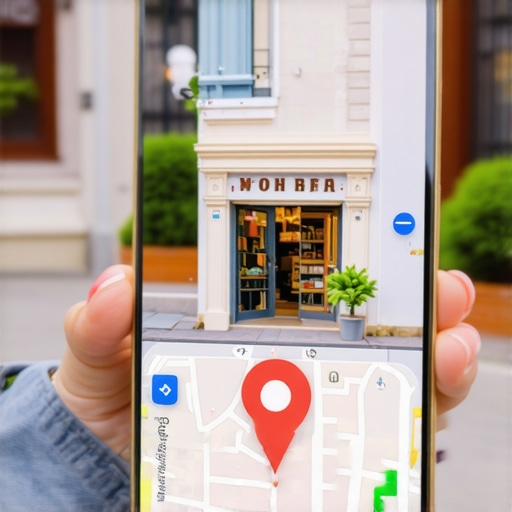
I was staring at my Google Business Profile dashboard for the fifth time that hour, and I honestly felt like I was losing my mind. The ‘Impressions’ number was huge. Thousands of people were seeing my business every month. But the ‘Phone Calls’ column? A big, fat zero. I had the five-star reviews and I thought I was mastering local maps domination, but the reality was a cold shower. People were looking at me, but they weren’t choosing me. They were scrolling right past my ‘professional’ logo and choosing the guy down the street who had a messy, real-life picture of his truck. That’s when the lightbulb finally flickered on. I realized that ranking is only half the battle; if your visual presentation is boring, you’re just a ghost in the machine. Today, I’m going to share the exact image optimization trick that turned my ghost town of a listing into a lead-generating machine.
Your Listing is Visible But Everyone is Ignoring It
I made a massive mistake early on that I see almost every small business owner repeat. I thought that ‘professionalism’ meant being sterile. I uploaded high-res stock photos of people in suits shaking hands. I spent a week perfecting a 4K version of my logo to use as the cover photo. I was so focused on my google my business rank that I forgot I was actually trying to appeal to human beings, not just algorithms. The result? I had high impressions but zero calls because I looked like a generic corporation instead of a helpful neighbor. People don’t want to hire a logo; they want to hire a person they can trust. When I finally swapped those polished stock images for ‘action’ shots of my team actually working, the click-through rate didn’t just crawl up—it exploded. Have you ever looked at your insights and wondered why all those views aren’t turning into actual phone calls?
Is this just another SEO gimmick that takes too much time?
You might be thinking that you don’t have time to become a professional photographer, or that ‘optimizing’ images sounds like more technical fluff. I felt the same way until I saw the data. Research from MIT suggests that the human brain can identify images seen for as little as 13 milliseconds. This means you have less than a blink of an eye to convince a searcher that you are the right choice before they scroll to your competitor. If your photo doesn’t communicate immediate trust and relevance, you’ve lost. This isn’t about fancy filters; it’s about using 4 image tweaks that stop searchers from scrolling. Once I implemented a specific way of framing my business ‘results’ in my photos, I finally achieved true map pack domination. You don’t need a DSLR; you just need to understand what the human eye is actually looking for in the local search results.
Human Faces Drive More Clicks Than Graphic Design
I’ve seen too many business owners treat their Google profile like a static billboard rather than a living, breathing conversation. Think of your listing like a digital storefront window. If the glass is covered in stiff corporate posters instead of showing the actual people and activity inside, people will just keep walking. I once consulted for a local plumber who had a perfect 5.0 rating but was losing calls to a guy with a 4.2. Why? Because the competitor had photos of himself actually crawling under sinks, while my client had a gallery of ‘Free Clip Art’ water drops. This isn’t just about looking ‘nice’; it’s about providing the interaction data that proves you are a top local choice. When you show a human face—preferably yours or your team’s—you bridge the trust gap in milliseconds. I forced my client to delete every stock photo and replace them with raw, unfiltered shots of his team in the field. Within two weeks, his call button gap closed significantly, and the phone actually started ringing again.
Post the Work You Are Doing Right Now
The biggest secret to mastering local maps domination isn’t a secret at all: it’s frequency. I remember a specific time I uploaded a photo of a messy, half-finished flooring job. I was embarrassed because the lighting was terrible and the room was a disaster, but I posted it anyway with a quick caption about the specific neighborhood. That single ‘ugly’ photo got more clicks than the professional portfolio shots I’d paid hundreds for. This happened because it proved we were actually working in that specific area. This is a massive part of a winning local mapping strategy because Google sees the GPS metadata attached to your smartphone photos. By taking a picture on-site, you are essentially telling the algorithm, ‘Yes, I am really here doing this job.’ This level of transparency is exactly how to outsmart competition in local map listings in 2025. Stop worrying about the perfect filter and start worrying about the proof of your presence.
Fresh Photos Signal a Thriving Business
If your last photo was uploaded in 2022, you are effectively telling every potential customer that you might be out of business. Google loves ‘freshness’ because it’s a proxy for reliability. You can’t just set it and forget it if you want a top-tier google my business rank. I make it a habit to upload at least three new photos a week directly from my phone. This signals to the map pack that this business is active and engaged. I’ve seen this work wonders for roofing companies where specific photo updates doubled local clicks almost overnight. It’s like keeping a garden; if you don’t water it with new content, the algorithm will let it wither and hide you behind the ‘View More’ button. Regularity is the fuel for the power of regular profile updates on search frequency, ensuring you stay top-of-mind and top-of-page. When searchers see a ‘2 days ago’ timestamp on your photos, they feel much more confident hitting that call button than they do on a listing that looks like a ghost town.
Stop Obsessing Over Your Total Review Count
Most ‘experts’ will tell you that the path to mastering local maps domination is simply getting more reviews than the guy across the street. But here is the truth: a massive stack of five-star reviews is a weak signal if nobody is actually interacting with them. I’ve seen listings with 500 reviews get buried by a competitor with 50 because the smaller listing had higher ‘dwell time.’ This is a huge nuance of how customer dwell time actually impacts your google my business rank. If people click your profile and immediately bounce back to search, Google assumes you weren’t the right fit. It’s about the interaction data that proves you are a top local choice. Have you ever fallen into this trap of chasing numbers instead of engagement? Let me know in the comments.
How does Google decide who is ‘relevant’ when everyone has five stars?
A recent study by Whitespark on local search ranking factors confirms that behavioral signals—like clicks to call, requests for directions, and photo views—are growing in importance while traditional citations are losing their punch. This explains why the shop next door outranks you with half the reviews. They aren’t just ‘lucky’; they are generating real human activity. If you are just using an automated bot to reply to customers, you are missing out on the specific review response patterns that actually boost map engagement. Google’s AI now reads those responses to understand the context of your service beyond the keywords.
The Proximity Trap That Limits Your Growth
One of the biggest ‘oops’ factors I see is businesses assuming they can’t rank outside their immediate neighborhood. They think their physical office address is a cage. This is what I call the proximity truth—your location matters, but it’s not the only factor. If you provide enough ‘prominence’ signals, you can force a massive map radius expansion that reaches much further than your competitors. People often fail because of the hidden setting that blocks your profile from neighboring towns, not because Google is playing favorites. When you understand how to outsmart competition in local map listings in 2025, you realize that relevance and authority can often beat physical distance. Don’t let a ‘safe’ local mapping strategy keep you from reaching the next zip code over. If you’ve noticed your local rankings drop off at a specific street corner, it’s usually a signal gap you can bridge with better data.
I used to think that hitting the top three was the finish line. I thought I could just coast once I saw my business name sitting pretty on that map. But the map pack is a moving target. If you aren’t active, you’re decaying. To stay ahead, I had to stop guessing and start using data-driven tools that actually show me where I’m winning and where I’m invisible. Most people rely on the native dashboard, but why your profile insights are lying to you about real phone calls is a lesson I learned the hard way. The ‘impressions’ Google shows you are often just people scrolling past you at 60mph on the digital highway. To truly own your territory, you need to see exactly where your signal drops off.
Stop Flying Blind and Start Tracking Your Real Search Radius
The single most important tool in my arsenal is a local grid tracker like Local Falcon. Instead of just checking my rank from my office chair, it shows me a bird’s-eye view of my mastering local maps domination progress across the entire city. It revealed that while I was #1 at my front door, I was #15 just two blocks away. This is how I identified the exact radius where your local rankings drop off. Once you have this map, you stop throwing spaghetti at the wall. You can see exactly which neighborhoods need more geo-tagged photos or localized posts. This level of precision is how to outsmart competition in local map listings in 2025 because while your competitors are broad, you are surgical.
How do I maintain my map rank without spending all day on it?
Maintenance is about systems, not luck. I’ve seen so many peers lose their spot because of why most businesses fail to hold a top spot in the map pack after three months—they simply stop the momentum. I use a simple ‘Rule of Three’: three new photos a week, three review responses, and one Google post. I treat my Business Profile like a social media feed. Even Joy Hawkins from Sterling Sky, a leading authority in local search, has noted that Google’s AI is increasingly sensitive to ‘activity clusters.’ If you go silent for a month, Google assumes you’ve gone stale. This consistent activity is the heartbeat of map pack domination. It’s better to do a little every week than a lot once a year.
The Future of Local Search is Verified Reality
Looking ahead, I predict Google is going to get even stricter about ‘Real-World Evidence.’ We are already seeing why your profile edits keep getting rejected and the proof google wants; they want to see your signage, your van, and your tools. In the next year, I expect video verifications and live ‘check-ins’ to become standard for maintaining a top-tier google my business rank. The ‘fakers’ using virtual offices and stock photos are going to be purged. If you want to scale, you need to document your work as it happens. This is why a solid local mapping strategy must include a workflow for your field team to snap and upload content daily.
If you’re feeling stuck, don’t try to fix everything at once. Start by running a ranking grid to see where you actually stand. Check out the profile audit checklist for turning search impressions into real calls and pick one gap to close this week. Whether it’s fixing your categories or adding a human face to your cover photo, one small move can trigger the algorithm to give you another look.
What I Finally Realized After Years of Fighting the Algorithm
Reflecting on my journey toward local maps domination, I’ve had a few lightbulb moments that changed everything. First, I stopped treating my profile like a resume and started treating it like a community bulletin board. The shift from corporate to human was the single biggest catalyst for my map pack domination secrets. I also learned that you cannot automate trust; the trap of review automation is real, and customers can smell a canned response a mile away. Real, messy, human interaction is what actually moves the needle in 2025.
Another hard truth? Most audits are skin-deep. I found that why most local SEO audits fail to catch profile errors often comes down to ignoring behavioral data in favor of simple keyword stuffing. If I could go back, I’d tell myself to focus 80% on user experience and only 20% on the technical ‘hacks’ everyone else is obsessed with.
The Toolkit That Keeps My Business on the Map
If you want to stay ahead, you need the right gear. I don’t go a single day without checking these resources: #IMAGE_PLACEHOLDER_E#
- Local Falcon: This is my go-to for visualizing my reach. It helps me see past the ‘office-centric’ view and understand my actual territory.
- Sterling Sky Blog: I trust the experts here because they test everything. If you’re going to hire help, you need to know the one question to ask a local SEO expert before signing a contract.
- Google Business App (Mobile): It sounds simple, but responding to messages and posting photos in real-time from the job site is a core part of a winning local mapping strategy.
The Map is Yours for the Taking
You don’t need to be a tech genius to achieve mastering local maps domination. You just need to be the most active, most transparent, and most helpful option in your neighborhood. The algorithm is designed to find the best local answer for a human question—so be that answer. Consistency beats intensity every time, so start small, but start today. Your business deserves to be seen, and more importantly, it deserves to be chosen. What’s the one photo you’ve been too ’embarrassed’ to post that actually shows your team in action? Let me know in the comments below!
About the Author
Umar Latif
Brand & Marketing Expert · Dubai, UAE
Umar Latif is a seasoned Brand and Marketing Expert based in Dubai, UAE, with a specialized focus on Local SEO and international digital strategy. With extensive experience managing and optimizing websites for a diverse range of international clients, including those in the United States, Umar has developed a deep understanding of the nuances required to dominate local search results. His technical proficiency encompasses comprehensive keyword research and the implementation of advanced Google-centric strategies designed to enhance visibility and drive organic traffic. As a contributor to dominateyourlocalmaps.com, Umar leverages his background in global marketing to provide actionable insights for businesses looking to improve their local map rankings and digital footprint. His approach combines data-driven tactics with a strategic brand perspective, ensuring that local businesses not only rank higher but also resonate with their target audience. Throughout his career, Umar has remained dedicated to staying ahead of search engine algorithm changes to deliver consistent results for his clients. He is deeply passionate about empowering business owners and marketing professionals with the tools and knowledge they need to achieve sustainable growth.