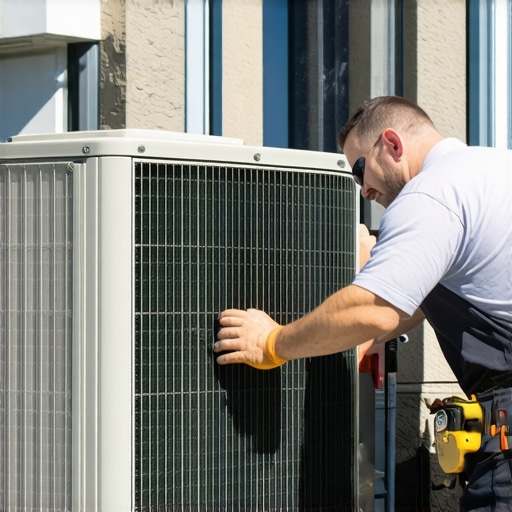
Why Your HVAC Business Only Shows Up in One Specific Zip Code
You’ve spent thousands on a pristine website, your trucks are wrapped, and your technicians are the best in the state. Yet, there’s a frustrating invisible wall. You rank #1 for “HVAC repair” in your home zip code, but as soon as a potential customer searches from two miles away – in the neighboring high-value suburb – your business vanishes from the Map Pack. This is the Proximity Paradox, a phenomenon where Google’s algorithm creates a “proximity bubble” around your verified address, effectively trapping your lead generation in a single neighborhood.
For HVAC business owners, google business profile seo is no longer just about filling out a profile; it’s about breaking out of this geographic cage. If you are struggling to reach customers in your full service area, you aren’t alone. Most contractors are fighting a losing battle against Google’s preference for physical distance over brand quality. In this guide, we will diagnose why your reach is stalled and how to engineer your digital presence to dominate multiple zip codes simultaneously.
Internal Link: The Proximity Paradox: Why Moving Your Store Location Won’t Always Help You Dominate Maps
The Three Pillars of the Google Maps Algorithm
To fix a ranking problem, you must understand the engine. Google’s local algorithm relies on three primary pillars: Proximity, Relevance, and Prominence. While these have been the standard for years, the weight shifted heavily toward Proximity in recent updates. Google prioritizes the physical distance between the searcher and the business address above almost all else.
For an HVAC business – typically categorized as a Service Area Business (SAB) – this creates a unique hurdle. Even if you hide your address, Google uses your “hidden” or “verified” address as the epicenter of your ranking power. If your shop is in a residential area on the edge of town, your “ranking radius” is naturally skewed toward that edge. Data suggests that Google’s “Local Filter” often removes businesses that are too far from the searcher’s GPS coordinates, even if those businesses have better reviews.
To overcome this, you must maximize the other two pillars. Relevance is how well your profile matches the search intent, and Prominence is how well-known your business is across the web. When proximity is a fixed constraint, your google business profile seo strategy must focus on making your relevance and prominence so undeniable that Google is forced to expand your ranking radius to provide the best user experience.
Service Area Business (SAB) vs. Storefront: The Hidden Ranking Penalty
There is a long-standing debate in the HVAC community: should you hide your address or show it? Research from the Local Search Forum suggests that businesses without a physical address shown inside the service area often have a “very hard time ranking” compared to those with a visible storefront. This is what many call the “Hidden Ranking Penalty.”
When you set up a Service Area Business (SAB) profile and hide your address, you are telling Google, “I go to the customers.” However, Google’s algorithm still needs an anchor point. If your competitor has a physical shop where customers *could* visit, they often receive a stronger “anchor” for google maps seo tools to latch onto. The algorithm views a physical storefront as a signal of higher “Entity Trust.”
The “Hybrid” Model Strategy: If you have a physical office or shop, even if 99% of your work is done at the customer’s home, showing your address can significantly boost your rankings. It provides a fixed coordinate for Google to measure prominence. If you are strictly a home-based business, you must compensate for the lack of a visible address by doubling down on local citations and geo-tagged content to prove you are active in those neighboring zip codes.
Internal Link: Why Your Google My Business Rank Fails 2026 Proximity Tests
Why “HVAC Contractor” Isn’t the Only Category You Need
Many contractors set their primary category to “HVAC Contractor” and stop there. This is a critical mistake in google business profile optimization. While “HVAC Contractor” is the essential foundation, it is often too broad to capture specific local intent in neighboring cities.
Research from RS Gonzales highlights that secondary categories are the secret weapon for expanding your reach. If a homeowner in the next zip code searches for “AC repair near me” and your primary category is just “HVAC Contractor,” but your competitor’s primary or secondary category is “Air Conditioning Repair Service,” Google will likely favor the competitor for that specific search. To rank higher on google maps, you should utilize categories like:
- Air Conditioning Repair Service
- Heating Equipment Supplier
- Furnace Repair Service
- Air Conditioning Contractor
The key is alignment. Your categories must match the services listed on your website. If you claim to be an “Air Conditioning Repair Service” on your Google Business Profile (GBP) but your website doesn’t have a dedicated page for that service, Google perceives a lack of Relevance, which shrinks your ranking radius back to your home zip code.
The “Entity Trust” Gap: Why Reviews Aren’t Enough
We often see HVAC owners frustrated because a competitor with 10 reviews is outranking them, even though they have 100 five-star reviews. This is the Entity Trust Gap. Recent insights from expert SEO Facebook groups highlight that rankings are heavily influenced by “overall entity trust” and “local relevance,” not just review count.
Google doesn’t just look at your GBP; it looks at the entire web to see if you are a “trusted entity” in a specific city. If your business is mentioned on the local Chamber of Commerce site, a local news blog, or a neighborhood sponsorship page in that neighboring zip code, your “Entity Trust” in that area increases. Local seo tools can help track these signals, showing you where your digital footprint is lacking.
High review counts are a “Prominence” signal, but if those reviews don’t mention specific locations or services (e.g., “Best AC repair in [City Name]”), they carry less weight for geographic expansion. Encourage customers to mention their neighborhood or city in their reviews to help bridge this trust gap.
Internal Link: Why the Shop Next Door Outranks You With Half the Reviews
5 Tactics to Expand Your HVAC Ranking Radius
Breaking out of a single zip code requires a proactive, multi-front strategy. Here are five tactics designed for the 2025-2026 local search landscape:
- Geo-Targeted Service Pages: Don’t just have one “Services” page. Create dedicated pages for every major city or suburb you serve (e.g., “HVAC Repair in [City A],” “Heating Services in [City B]”). These pages should include local landmarks, neighborhood names, and specific local climate challenges.
- Hyperlocal Content: Write blog posts addressing local issues. For example, “How the hard water in [City Name] affects your boiler’s lifespan.” This signals to Google that you are an expert *in that specific location*.
- Map Embeds: Properly embed a Google Map on your city-specific pages. This isn’t just for show; it reinforces the connection between your business and the service area. Why Your Map Embed Strategy Isn’t Translating Into Local Rankings.
- Local Citations: Use citation building services to ensure your NAP (Name, Address, Phone Number) is consistent across local directories, but specifically target directories that are relevant to the neighboring zip codes you want to conquer.
- Human Signals (The 2026 Frontier): Google is increasingly looking at “Human Signals” like NFC Interactions and “Verified Visit Search.” If customers in a neighboring city are searching for your brand name specifically or interacting with your profile via mobile devices, Google recognizes your relevance in that area. 5 NFC Interaction Fixes for Google My Business Rank [2026].
By implementing these, you move from being a “zip code business” to a “regional authority.” To facilitate this growth, using a professional google maps ranking service can automate the technical heavy lifting of signal generation.
Diagnostic Checklist: Why You Aren’t Ranking “Next Door”
If your rankings have stalled at the city line, run through this quick-fire audit to find the leak in your local SEO engine:
- Primary Category Check: Is your primary category the most specific one for your highest-revenue service?
- Service Area Settings: Have you explicitly listed the zip codes or cities in your GBP dashboard? (Note: Don’t overdo it; keep it realistic).
- NAP Consistency: Does your address on your website’s footer match your GBP exactly?
- Location-Specific Backlinks: Do you have any links from websites based in the neighboring zip code?
- Audit Tools: Are you using a google business profile audit tool to check for keyword stuffing or category conflicts?
Internal Link: The 10-Minute Local SEO Audit That Uncovers Why Your Rankings Stalled
Conclusion & The Path to Map Pack Domination
In the world of HVAC marketing, proximity is a hurdle, but it is not a dead end. While Google’s algorithm naturally favors the business closest to the searcher, you can jump over that bias by maximizing your Relevance and Prominence. By building “Entity Trust” through hyperlocal content, strategic categorization, and modern human signals, you can expand your reach far beyond your home zip code.
The first step to fixing your visibility is seeing the reality of your current reach. Use a google maps rank tracker to visualize your “ranking heat map.” Once you see where the “invisible wall” is, you can start breaking it down. For advanced automation and tools to accelerate this process, visit SEO Viper Tools and take control of your local territory.
About the Author
Umar Latif
Brand & Marketing Expert · Dubai, UAE
Umar Latif is a seasoned Brand and Marketing Expert based in Dubai, UAE, with a specialized focus on Local SEO and international digital strategy. With extensive experience managing and optimizing websites for a diverse range of international clients, including those in the United States, Umar has developed a deep understanding of the nuances required to dominate local search results. His technical proficiency encompasses comprehensive keyword research and the implementation of advanced Google-centric strategies designed to enhance visibility and drive organic traffic. As a contributor to dominateyourlocalmaps.com, Umar leverages his background in global marketing to provide actionable insights for businesses looking to improve their local map rankings and digital footprint. His approach combines data-driven tactics with a strategic brand perspective, ensuring that local businesses not only rank higher but also resonate with their target audience. Throughout his career, Umar has remained dedicated to staying ahead of search engine algorithm changes to deliver consistent results for his clients. He is deeply passionate about empowering business owners and marketing professionals with the tools and knowledge they need to achieve sustainable growth.